
To 1900
Football didn’t start with glossy magazines, colour photography and sponsor wraps. For much of the Victorian era, a “programme” was a modest piece of paper sold at the turnstiles: a practical guide for supporters who wanted the team names, kick-off time, officials and a few local notices. Many were closer to a match bill than what we’d recognise today, and plenty were never designed to survive beyond the final whistle. That’s exactly why programmes from before 1900 are so compelling. They’re not just football ephemera; they’re rare, fragile snapshots of the game learning what it was going to become.
These earliest issues sit at the crossroads of sport, printing and community life. You’ll see clubs still finding their identity, competitions gaining prestige, and grounds evolving from simple enclosures into the beginnings of true football venues. Details that look ordinary on the page can be gold to collectors and historians: the spelling of a player’s name, a ground address, an admission price, a change in club colours, a list of committee members, or an advert for a local tailor who also happened to be a director. In an era when news travelled slowly and record-keeping wasn’t always systematic, programmes often fill the gaps that newspapers and yearbooks leave behind.
Because survival rates are low, every genuine pre-1900 programme carries a sense of chance. Some were kept as souvenirs of cup ties, benefit matches or notable firsts; others endured simply because someone tucked them into a drawer and forgot. Condition matters, of course, but so does provenance and context. A faint pencil note, a stamped club office mark, or a programme folded into quarters can tell you as much about matchday habits as the printed line-up itself.
This page brings together the programmes to 1900 as a dedicated reference point within the wider 10Footballs collection. Whether you’re researching a club’s earliest seasons, chasing a specific competition, or simply fascinated by the roots of matchday culture, you’ll find this section a useful starting place. Browse through, compare formats and layouts, and use it to place later programmes in perspective. Once you’ve seen where football printing began, you’ll never look at a modern programme in quite the same way.
-

Queens Park v Wanderers 09.10.1875 Lord Kinnaird & his English cup holders beaten 5-0
-
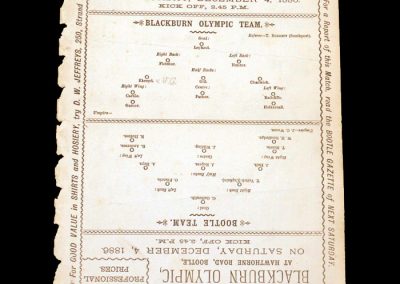
Bootle v Blackburn Olympic 04.12.1886 (Olympic were the 1st professional team, as well as the 1st from the North to win the Cup in 1883)
-

Windsor v Eton 20.06.1887 & 22.06.1887 - Queen Victoria Jubilee
-

Liverpool v Middlesbrough Ironopolis 22.09.1892 Very early days for Liverpool. Ironopolis didnt survive.
-
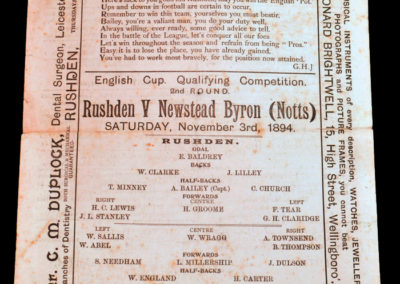
Rushden v Newstead Byron 03.11.1894
-

Frankfurt v English Combination 30.03.1895 (Rugby)
-

Sunderland Championship Celebration Invitation 02.05.1895
-

1896/97 Doncaster Rovers Season Ticket
-

Aston Villa v Everton 10.04.1897 (English Cup Final) Villa do the double.
-

Aston Villa 1896-97 Team Photo
-

Ryde v Southampton 27.12.1897
-

Lowestoft v Aston Villa 28.02.1898
-

Reading v Burnley 11.04.1898
-

Sheff Utd v West Brom 11.04.1898 (Foulkes)
-

Newcastle A v Sunderland A 31.12.1898
-

Newcastle A v Sunderland A 31.12.1898 Newcastle`s first season in the "premier" league. Jack Peddie got most of the goals. Probably the 1st great Geordie No 9.


