
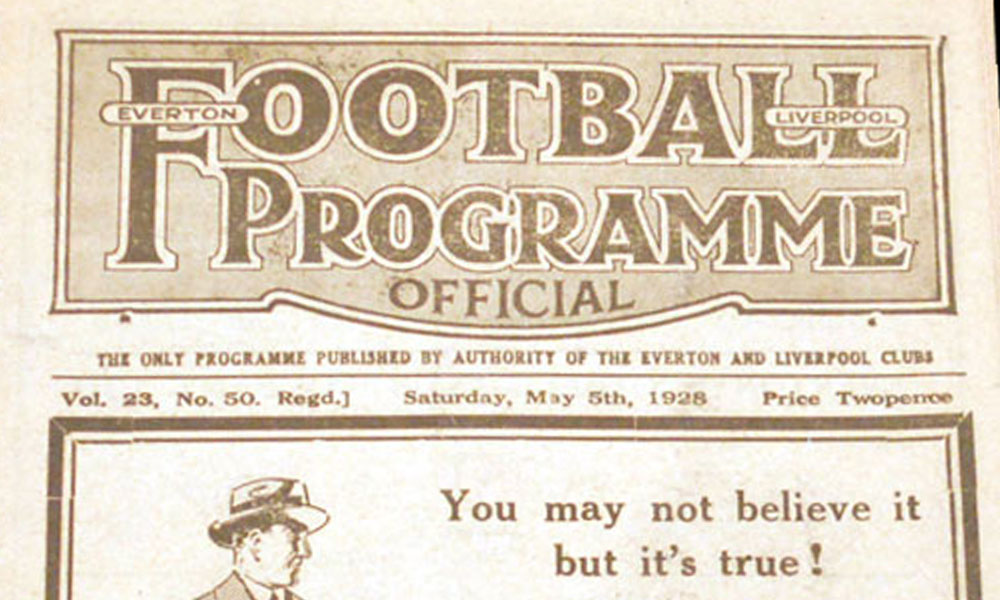
Some football programmes record a match. A few capture a moment. The Everton v Arsenal issue dated 5 May 1928 does something more unusual – it freezes the exact afternoon when William Ralph “Dixie” Dean turned himself into a legend, hitting 60 league goals in a single season, a record that still looks untouched nearly a century later.
For collectors, that flimsy Goodison Park Everton programme is not just paper and print. It is the match ticket to one of English football’s most famous feats.
From Tranmere teenager to Everton’s number nine
Dean’s story starts across the water at Tranmere Rovers, where as a teenager he was already averaging a goal a game. Everton were quick to act, bringing him to Goodison and handing him the number nine shirt that he would make his own.
It was not all smooth progress. A serious motorcycle accident left him with a fractured skull and raised doubts about whether he would ever be the same player again. When he returned in a reserve match at Huddersfield in October 1926, all eyes were on his heading – surely the part of his game most at risk. He promptly demonstrated that his ability in the air was as ferocious as ever, reassuring himself and everyone watching.
International recognition followed. After impressing in an England trial in early 1927, he made his debut against Wales, scoring twice, and repeated the feat against Scotland at Hampden Park a few weeks later. The goals, at club and country level, simply kept coming.
1927–28: chasing the title and a record
By 1927–28, Dean was the spearhead of an Everton side locked in a title battle with Huddersfield Town, who were chasing a league and cup double. Huddersfield would finish runners-up in both; Everton secured the championship with a game to spare.
That is where the programme for the final match comes in. On the team page, Everton’s list of league goals shows Dean on 57, followed by Troup with 10 and Weldon with 7. The team’s total sits tantalisingly at 99.
The title was already won. The questions left were for the statisticians and the romantics: could Dean score the hat-trick he needed to beat George Camsell’s record of 59 league goals, set for Middlesbrough the previous season in Division Two – and could Everton take their tally beyond 100?
-

Everton v Arsenal 05.05.1928 (Dixie gets his 58th, 59th & 60th goals of the season)
-

Everton v Birmingham 11.12.1937 (Dixies last in the 1st team)
-

Arsenal v Everton 29.08.1936 (Dixie equals Bloomers record)
-

England 11 v Scotland 11 07.04.1964 - Dixie Dean Testimonial at Goodison


“The Arsenal” arrive – and Charles Buchan bows out
The visitors that day were still generally referred to as “The Arsenal”. They had not yet become the dominant force of the 1930s but were on the way, building under Herbert Chapman and assembling the pieces of a great side.
The fixture had particular significance for one man in red and white: inside-forward Charles Buchan. Formerly of Sunderland and England, he had joined Arsenal three seasons earlier on an unusual deal – a fee to Sunderland plus a payment per goal he scored, which proved costly when he hit 21 in his first campaign. Now, at Goodison Park, he was making his final appearance before retiring to pursue sports journalism, a career that would see him edit his own hugely popular football magazine.
Buchan would later write that Arsenal did not take it easy that afternoon. They wanted to win for him, to send him out on a high. The 3–3 scoreline supports his claim; this was no end-of-season stroll.
The match: pressure, penalties and a flicked header
Arsenal struck first. Any notion that they would simply stand back and let Dean chase history evaporated early on.
Everton’s number nine replied in the way he knew best, with a neat header to level the scores and move himself to 58. Shortly afterwards he stepped up to the penalty spot, converted, and pulled level with Camsell on 59. All this happened very early in the game, leaving around 85 minutes for the decisive moment.
What followed was a long, tense hunt for a single goal. The crowd knew the numbers. So did the players. Every half-chance fell silent for a heartbeat as Goodison held its breath. Only in the closing minutes did it finally happen: another cross, another leap, another glancing, flicked header from Dean. Sixty league goals. Everton past the 100 mark. Pandemonium.
Arsenal found an equaliser to make it 3–3, but almost nobody in the ground cared. Everton were champions. Dixie Dean had done the impossible.
“I scored a hundred” – counting every strike
Officially, Dean’s league tally that season was 60. Unofficially, he always insisted he reached a round century in all competitions and representative matches. In his own reckoning he added:
- League goals
- FA Cup strikes
- Inter-league games
- Charity and benefit matches such as the Blackpool Hospital Cup and a fixture for the Fleetwood disaster
- England appearances
- Club tours and trials
Some of those numbers rely on taking his word for it, but that is part of the charm. For programme collectors, tracing those goals through different competitions – league fixtures, cup ties, charity games, international line-ups – is a treasure hunt through the printed record of his season.
Rollercoaster years: relegation, revival and Wembley
The story did not end with that 1928 programme. Everton and Dean rode a rollercoaster in the years that followed. The club were relegated to Division Two in 1929–30, bounced straight back as champions in 1930–31 and then won the top-flight title again in 1931–32. Through it all, Dean kept scoring, including a goal in England’s 7–1 demolition of Spain in 1931.
In 1933 he completed his domestic set at Wembley. Everton reached the FA Cup Final and beat Manchester City 3–0; once again, Dean’s trademark gliding header provided the second goal. League titles, cup, records – by his mid-twenties, he had won it all.
Chasing Bloomer, welcoming Lawton
Inevitably, injuries began to bite. Significant knocks kept Dean out for spells and his totals dipped. He knew, as early as April 1934, that Everton were already searching for his successor.
Even so, he moved relentlessly towards Steve Bloomer’s league record of 352 goals. Dean equalled that total at Highbury against Arsenal in August 1936, then surpassed it a few days later at Goodison against Sheffield Wednesday. He earned selection for the English League XI to face the Scottish League at Goodison in October 1936 – his final representative honour.
That Christmas, Everton signed 17-year-old centre-forward Tommy Lawton from Burnley for a hefty fee. Initially the youngster played alongside Dean, but when Lawton scored a superb goal against Spurs in the FA Cup, the older man is reputed to have muttered, “That’s it. That’s the swansong.”
Chairman Will Cuff later remarked that the rest of the team had developed a “Dean complex”, playing to him so much that it harmed their teamwork. The writing was on the wall.
Exit, exile and enduring hero status
Dean’s last first-team game for Everton came against Birmingham on 11 December 1937. He spent most of that season in the reserves and, in March 1938, was told that Notts County wanted him and he was to be sold. It was a flat, unsentimental end for a club icon.
The move did not really work out and he soon left the Football League behind, heading to Sligo Rovers in Ireland, where he was treated as a conquering hero. War then intervened and his professional career effectively ended.
Back in England, he ran a pub in Chester and remained a beloved figure among Everton supporters. In April 1964, more than 30,000 turned up at Goodison for a belated testimonial, a final public thank-you to the man whose goals had defined an era.
Why that Arsenal programme matters
For all of that rich life and long career, collectors still come back to one afternoon in May 1928. The Everton v Arsenal programme from that day does what the best pieces of football memorabilia always do: it anchors a legend in something you can hold.
There is Dean’s name with 57 league goals beside it. There is the total of 99, inviting the question of whether he can push it into three figures. There is the opposition, “The Arsenal”, and the note in the match reports that this was Charles Buchan’s final game.
Everything else – the fractured skull, the hundred goals he claimed, the Wembley header, the chase of Bloomer, the arrival of Lawton, the pub in Chester – flows out from that moment. On 10footballs.com, that is what makes the programme so special: not just that it records a 3–3 draw, but that it marks the day Dixie Dean reached 60 and ensured his name would be spoken wherever football history is told.