
Liverpool’s history is packed with big nights, bigger trophies and some of the most passionate support in the game. It is no surprise, then, that Liverpool programmes are among the most collected and talked-about items in the hobby. From fragile pre-war issues to European Cup finals and modern Champions League glory, each programme is a paper time capsule of the club’s story.
This overview looks at some of the most sought-after and most valuable Liverpool programmes, and why they matter so much to collectors who love both the club and football memorabilia in general.
Early Anfield rarities
At the very top end of the market sit the earliest home programmes from the 1890s and early 1900s. Many of these were printed in tiny numbers, often on thin, cheap paper that simply did not survive everyday use.
Any genuine pre–First World War Anfield issue will be scarce; programmes from Liverpool’s first seasons in the Football League are among the most valuable Liverpool programmes you will ever see. Condition is often poor by modern standards – folded, browned, sometimes torn – but that only underlines their age and authenticity.
For serious collectors, these early issues are the foundation stones: proof on paper of Liverpool’s emergence from local side to league club.
The first FA Cup Final: 1914
Liverpool’s first appearance in an FA Cup Final came in 1914 against Burnley at Crystal Palace. They lost 1–0, but the match programme is now a classic. It sits at the crossroads of eras: the final before the First World War, the club’s first shot at the Cup, and one of the grand old Palace finals that collectors of football memorabilia prize so highly.
Original copies are rare, and well-kept examples with intact covers and minimal writing command serious interest whenever they appear.
-

Aston Vila v Liverpool 28.03.1914 (English Cup Semi Final)
-

Burnley v Liverpool 14.03.1914


Post-war Anfield and the 1950 FA Cup Final
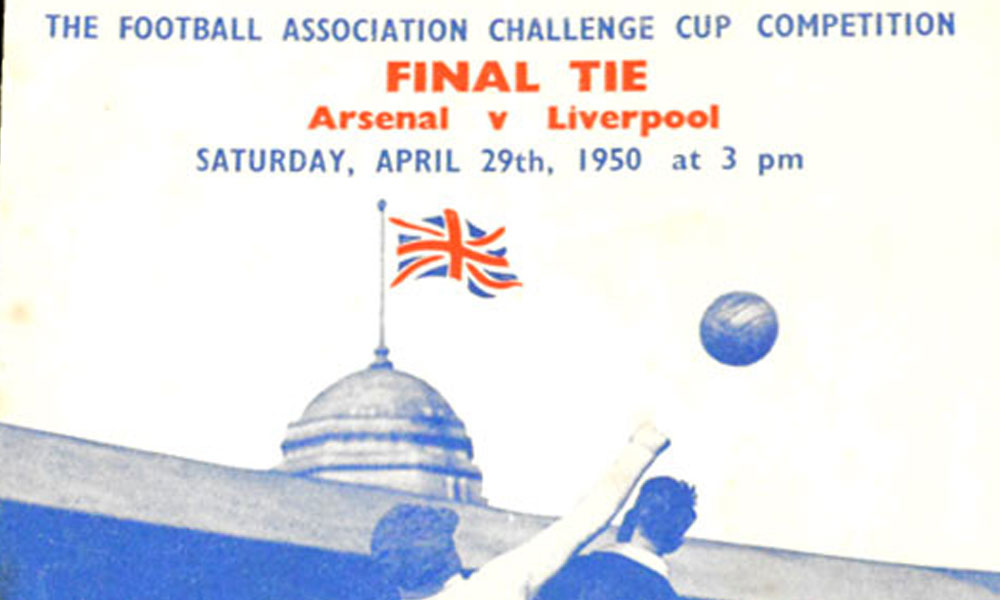
The 1950 FA Cup Final against Arsenal at Wembley is another key entry in any list of notable liverpool programmes. It was Liverpool’s first post-war final, and tens of thousands of supporters travelled south, many holding onto their programme as a treasured souvenir whether they attended or followed from afar.
As with many mid-century finals, there are differences in value depending on condition, line-up changes and whether token pages are intact. For many supporters, this programme also marks the moment when Liverpool began to feel like a modern big club again after the disruption of the war years.
Alongside Wembley, home programmes from the late 1940s and early 1950s – especially those involving title challenges and big-name visitors – are also increasingly sought after, as collectors look to complete runs of seasons rather than chase only the biggest finals.
-

Arsenal v Liverpool 29.04.1950 - FA Cup Final
-

Everton v Liverpool 25.03.1950 - FA Cup Semi Final
-

Chelsea v Arsenal 18.03.1950 - FA Cup Semi Final


Shankly, promotion and the first great side
By the early 1960s, Bill Shankly was transforming both team and club. Programmes from key milestones in that era are favourites in many collections:
- Promotion back to the First Division
- The 1963–64 title-winning season
- European nights returning to Anfield
These issues are easier to find than pre-war rarities, but they sit in the sweet spot where nostalgia, design and history all come together. The style of Liverpool’s home programmes evolves through this era, with different cover layouts and advertising giving each season its own character.
1965: lifting the FA Cup at last
For Liverpool supporters, 1965 is a line in the sand. After decades of trying, the club finally lifted the FA Cup, beating Leeds United at Wembley. The match programme is one of the most collected Liverpool issues of all, cherished not just for its value but for what it represents.
Many fans who travelled that day kept their programme folded in a pocket, then carefully stored it away afterwards. Today, the difference between a handled “I was there” copy and a pristine one can be seen in the price, but both tell a story. For some collectors, a slightly worn example feels closer to the day itself.
-

Liverpool v Chelsea 27.03.1965 (FA Cup semi final)
-

FA Cup Final | Liverpool v Leeds 01.05.1965


European glory: Rome, Wembley and beyond
Liverpool’s rise as a European force in the 1970s and 1980s produced a string of programmes that are central to any discussion of the most valuable Liverpool programmes. Among the most prized are:
- 1973 UEFA Cup Final (two legs)
- 1977 European Cup Final v Borussia Mönchengladbach (Liverpool’s first European Cup)
- 1978 European Cup Final v Club Brugge at Wembley
- 1981 European Cup Final v Real Madrid in Paris
- 1984 European Cup Final v Roma in Rome
Each of these programmes carries its own weight of meaning. The first European Cup in 1977 stands out for many, but collectors often aim for a complete set of European finals, along with home programmes from famous Anfield nights such as the comeback against Saint-Étienne in 1977.
Those European Anfield issues – quarter-finals and semi-finals, not just finals – are sometimes overlooked outside Liverpool circles, but they are cherished locally, and demand has grown as a new generation discovers those stories.
Tragedy and remembrance
Any overview of Liverpool programmes has to acknowledge the more sombre side of collecting. Programmes associated with tragedies, particularly the 1985 European Cup Final at Heysel and the 1989 FA Cup semi-final at Hillsborough, sit in a very sensitive space.
Some collectors choose not to pursue these issues out of respect; others keep them as part of a commitment to remembrance and education. Where they do appear in collections or on specialist sites, they are usually handled with care and context rather than treated as just another “rare” item.
For many supporters, these programmes are not about monetary value but about never forgetting the events and the people connected to them.
Istanbul and the modern era
Fast-forward to 2005 and another defining night: the Champions League Final in Istanbul. The match programme from Liverpool’s comeback against AC Milan is already firmly established as a must-have for modern collectors. Many who travelled that night still have their original copy; demand from younger fans means this is likely to remain one of the standout modern Liverpool programmes.
Programmes from more recent triumphs – the 2019 Champions League Final, the Club World Cup win, and key matches from the 2019–20 title-winning season – are starting to take their place in collections too. While they are not rare in the way early 20th-century issues are, they mark moments that future generations will look back on in exactly the same way supporters now talk about 1965, 1977 or 1984.
Home v away, condition and the small details
With all Liverpool programmes, value is shaped by more than just the fixture. Collectors look at:
- Home versus away issues (away programmes from famous games can be harder to find)
- Whether the correct token, insert or voucher is still present
- Team changes, late reprints and misprints
- Signatures – genuine autographs from players or managers
- Overall condition: cover gloss, staple rust, writing or marks
Sometimes a relatively ordinary league game becomes highly collectable because of a quirk on the day – a debut, a record, a farewell – noted in the programme. That is part of the appeal: discovering stories hidden in plain sight.
Building a Liverpool collection
For anyone starting out, it is rarely realistic to chase the very earliest or absolute most valuable Liverpool programmes first. A more rewarding path is to focus on themes:
- All finals and semi-finals
- European home programmes from Shankly and Paisley eras
- Key seasons (first titles under particular managers, centenary years, landmark anniversaries)
- Personal milestones – the first match you attended, or programmes that connect to family memories
Sites like 10footballs exist precisely to bring those stories together. A single Liverpool programme is a lovely object; a small group, arranged around a theme, becomes a narrative you can hold in your hands. Whether your interest is in Rome, Wembley, Istanbul or the earliest days at Anfield, there is a corner of Liverpool’s printed history waiting to be explored.