
Few clubs in world football have a story as rich – or as collectible – as Liverpool. From early league titles to European dominance and modern Champions League miracles, the club’s biggest nights have been captured in print on the front of humble matchday programmes. For collectors, the most sought-after Liverpool programmes combine historic moments, evocative cover designs and genuine rarity.
This guide takes a club-focused look at some of the issues that mean the most to collectors – from early Anfield days and the opening of the Kop to European nights, title deciders and cup finals – and explains what to look for in terms of rarity, condition and long-term value.
Early days at Anfield – where the story begins
For specialists in football programmes, Liverpool’s earliest issues are the foundation stones of any serious collection. One particularly important example is the programme for Liverpool v Middlesbrough Ironopolis in the club’s first years. Anfield was still finding its feet, Ironopolis would soon vanish from the league, and surviving copies from this era are incredibly scarce, with an example noted in the “To 1900” section on 10footballs.com.
Slightly later pieces from the early 1920s also carry strong appeal. The programme for Liverpool v Stoke City in May 1923, issued as the club secured the championship, is a classic “champions” memento – a tangible reminder of an early title-winning side and a snapshot of design and advertising from between the wars.
These very early Liverpool programmes are valued not just for age, but for survival. Print runs were modest, many were discarded on the day, and those that remain often show heavy wear. Clean, complete copies with intact staples are prized.
“The Kop opens” – Bury 1928 and the terrace that defined a club
If there is one pre-war home issue that every Liverpool collector knows, it is the souvenir programme for the opening of the completed Spion Kop new stand against Bury on 25 August 1928.
This isn’t just any league game: the Kop is central to Liverpool’s identity, and the club produced a special programme with gilt cover and ribbon binding to mark the event. Auction records show strong demand for high-grade examples, especially where the cover retains its colour and the ribbon is present. For many, this is the key pre-war Anfield issue, bridging stadium history and terrace culture in a single piece of print.
European nights at Anfield – Inter, Saint-Étienne and beyond
Say “European night at Anfield” and most collectors will immediately think of programmes from the 1960s and 70s. Two fixtures stand out.
The first is Liverpool v Inter in the European Cup semi-final, first leg, played on 4 May 1965. The Reds’ 3–1 win, under the lights and swirling flags, has become part of club folklore. The programme, with its mid-60s design and continental glamour, remains a favourite. Condition is often an issue – many copies show folds from being waved during the match – so crisp, flat examples command a premium.
The second is the Liverpool v Saint-Étienne programme from 16 March 1977, the night many fans still call Anfield’s greatest European performance. Liverpool’s 3–1 victory sent them on their way to a first European Cup triumph in Rome, and the programme is collected as much for the story it represents as for the cover.
Later European home issues – such as those from epic ties against Roma, Chelsea and Barcelona – also attract strong interest, but Inter ’65 and Saint-Étienne ’77 remain the quintessential “European Anfield” Liverpool programmes.
Cup finals and title deciders – Wembley and Rome
No guide to liverpool programmes would be complete without the 1965 FA Cup Final. The Leeds United v Liverpool issue from Wembley on 1 May 1965 marks the club’s first FA Cup win and features both teams on the cover. Collectors look out for different variants and subtle printing differences; as ever, light folds and scorer notes inside affect value, but even well-handled copies remain highly collectable as a gateway piece for newer fans.
European Cup and Champions League finals open up another tier of must-have football programmes. Among the most significant are:
- 1977 European Cup Final, Liverpool v Borussia Mönchengladbach in Rome – the club’s first European Cup win and the culmination of that Saint-Étienne run.
- 1978 Final v Club Brugge at Wembley, completing back-to-back European titles.
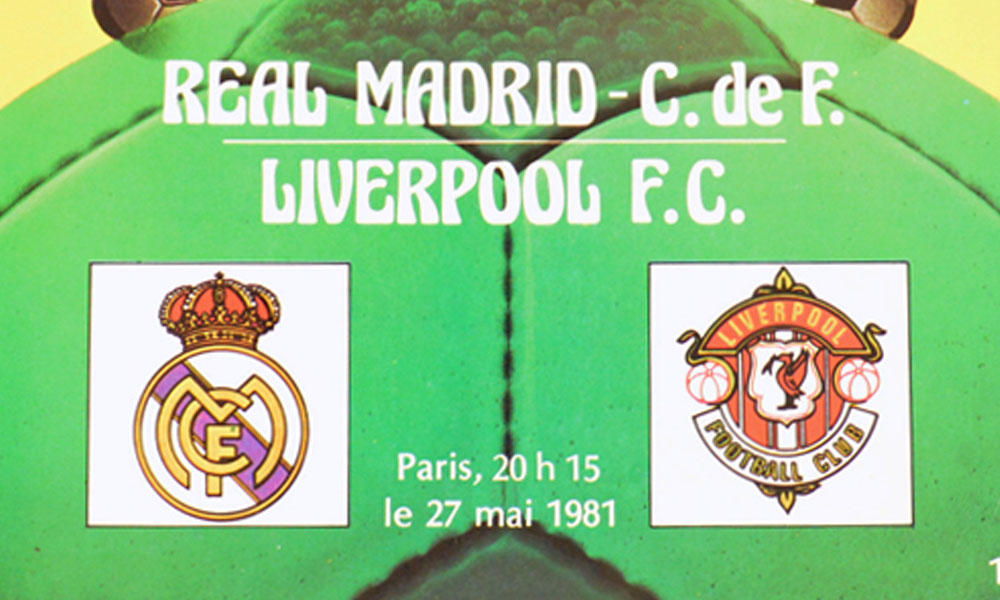
- 1981 Final v Real Madrid in Paris and the 1984 Final v Roma in Rome, both represented by highly sought-after issues in home and local editions.
- 2005 Champions League Final v AC Milan in Istanbul – a modern classic, with programmes tied closely to memories of the comeback in the Atatürk Stadium.
For many collectors, these finals form the spine of a Liverpool European set, with away-edition programmes often much scarcer than the English-language issues sold to travelling supporters.
-

Liverpool v Bruges 10.05.1978 (European Cup FInal) (DT was there)
-
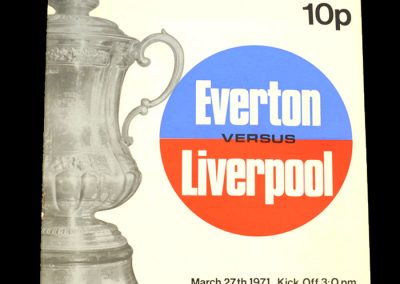
Everton v Liverpool 27.03.1971 - FA Cup Semi Final
-

Man Utd v Liverpool 21.05.1977 - FA Cup Final
-

Liverpool v Roma 30.05.1984 - Europen Cup Final


Rarity: print runs, survival and special editions
Rarity in liverpool programmes is shaped by more than age alone. Factors include:
- Print run size – early friendlies and minor cup ties often had smaller runs than finals or glamour fixtures.
- Occasion – special events like the opening of the Kop or testimonial matches sometimes had souvenir editions with lower survival rates.
- Home vs away – away issues, especially from continental fixtures, can be significantly harder to find.
- Variants – different price prints, reprints or local-language editions can become sub-collections in their own right.
On 10footballs.com, you can see this variety in the way Liverpool appears across different eras: from 19th-century friendlies to 1920s champions’ issues and later European adventures, each programme telling a slightly different part of the story.
Condition: how much does it matter?
Condition is crucial in the world of football programmes. Collectors will typically grade items along a spectrum from poor to mint, with key details including:
- Folds and creases – inevitable for big games, but heavy central folds reduce value.
- Writing – team changes and scorer notes were common on the day; purists prefer clean copies, but some enjoy the sense of “match-used” history.
- Rust – staple rust and staining, especially on older issues, are common but can be a downside at the top end of the market.
- Completeness – missing tokens, coupons or adverts detract from value, especially on souvenir editions like the Kop opening.
For rare early Liverpool programmes, collectors may accept more wear simply because so few survive. For 1960s onwards issues, expectations are higher and condition differences are reflected more sharply in price.
Building your Liverpool collection
For newcomers, it can be tempting to chase everything at once. A more sustainable approach is to build around themes:
- Early Anfield and pre-war history.
- League titles and landmark domestic seasons.
- European nights at Anfield.
- European Cup/Champions League finals, home and away editions.
From there, you can branch out into more specialised areas – reserve issues, pre-season tournaments, testimonials and oddities. Because 10footballs is structured season by season and era by era, it’s a useful way to spot gaps and plan the next additions to your shelves.
In the end, the Liverpool programmes that matter most are the ones that bring the club’s history to life for you: the Kop’s first roar under a new roof, the green shirts of Saint-Étienne under Anfield lights, a red-bordered Wembley final or a sun-drenched European night in Rome. Collecting them is not just about paper and staples – it’s about owning small, vivid pieces of football history that will never be replayed in quite the same way again.