
Between the early 1930s and the late 1940s, England v Italy was never just another international. On one side you had England, self-appointed guardians of the game, proudly aloof from the World Cup in their “splendido isolamento”. On the other, Italy – back-to-back world champions in 1934 and 1938, and holders until 1950 – driven on by a regime that saw football as a propaganda tool, fronted by an Alexei Sayle lookalike called Mussolini.
Label these matches “friendlies” if you like; in reality they were prestige contests, footballing culture clashes and, eventually, poignant markers either side of a world war. For collectors, the programmes and tickets from 1933, 1934, 1939 and 1948 tell that whole story in miniature.
1933 Rome – debuts, diplomacy and Il Duce in the stands
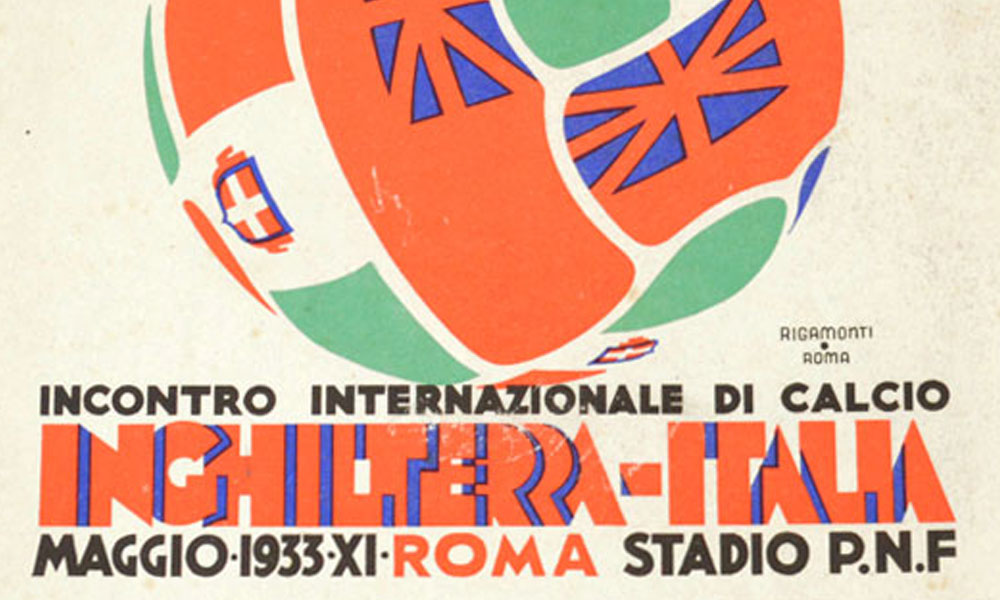
The first meeting of the era came on 13 March 1933 in Rome. England arrived as the game’s inventors; Italy, under Vittorio Pozzo, were rapidly becoming its ruthless modernisers. Before a ball was kicked, the English players were given an audience with Mussolini and taken to see the Pope – tourism instead of wages in an age before appearance fees.
On the pitch, England were almost experimental. Six players won their first cap; two more, Bastin and Hunt, were making just their second appearances. Italy, by contrast, fielded a far more seasoned XI: nine of their side already had a dozen caps or more. They were better paid, battle-hardened and roared on by 50,000 in the stadium, Il Duce and the fascist hierarchy among them.
Ferrari opened the scoring for Italy; Bastin equalised, and the game finished 1–1. No humiliation, no statement victory, but plenty of needle and pride. The Rome football programme from that day, with its period imagery and line-ups, is a snapshot of a football world sliding into darker politics – and of an England side still assuming they sat above the international fray.
-

England v Italy 14.11.1934
-

Italy v England 13.05.1939 | Romania v England Postcard 24.05.1939
-

England v Italy 30.11.1949
-

Italy v England 16.05.1948
-
![Italy v England 16.05.1948 (Ticket [reverse] and Magazine)](https://10footballs.com/wp-content/uploads/2018/06/865-400x284.jpg)
Italy v England 16.05.1948 (Ticket [reverse] and Magazine)
-
England v Italy 13.05.1939
-

Italy v England 13.05.1933
-

England v Italy 13.05.1933


![Italy v England 16.05.1948 (Ticket [reverse] and Magazine)](https://10footballs.com/wp-content/uploads/2018/06/865.jpg)


1934 Highbury – the Battle that wasn’t quite “friendly”
If Rome felt like a dress rehearsal, 14 November 1934 at Highbury was the main event. Italy had just won the World Cup on home soil. England, having refused to enter, were determined to prove that their best could beat the world champions. Seven Arsenal players started for England; north London felt like the centre of the football universe.
What followed went down in history as the “Battle of Highbury”. According to captain Eddie Hapgood, it was “the dirtiest game I ever played in”. Within two minutes, Italian centre-half Monti collided with Ted Drake and suffered a broken bone in his foot. With no substitutes allowed, Italy played virtually the entire match with ten men. Whether they believed the injury was accidental or something more sinister, their response was brutal.
Hapgood had his nose broken by a flying elbow and spent 15 minutes off the pitch. Brook suffered a broken arm. Bowden turned an ankle. Male, Drake and Barker collected various minor war wounds. In return, England raced into a 3–0 lead inside a quarter of an hour: Brook missed a penalty but scored twice from open play, Drake added the third.
In the second half, Giuseppe Meazza – one of Italy’s all-time greats – pulled two goals back, and the game finished 3–2. The England dressing room, by all accounts, looked like a casualty clearing station. Pozzo later claimed his players did not realise quite how badly Monti was injured in those early minutes; how far that excuses the violence is another matter entirely.
For football programme collectors, the Highbury issue is one of the crown jewels: seven Arsenal names in the England XI, the world champions in town, and behind the neat team lists, the memory of ninety minutes that left bruises far deeper than the final scoreline.
1939 Milan – “Match of the Century” on the eve of war
By the time England travelled to Milan on 13 May 1939, Europe was on the brink. War was less than four months away, yet this game was billed as the “match of the century”: the masters against the world champions, one more time.
A crowd of 70,000 packed into San Siro. Unlike Highbury, the atmosphere was sporting rather than spiteful, but the stakes still felt high. The match finished 2–2, remembered above all for Italy’s second goal: Piola punching the ball into the net in a fashion Maradona would copy, and refine, nearly half a century later – with the added flourish of following through and flattening England full-back George Male.
Honours even again, but in hindsight this was a farewell: the last great pre-war meeting of two footballing powers. The Italian magazine coverage, tickets and English tour literature from that trip – often found alongside the Milan programme – have become highly prized. They mark the end of an era when international football could still pretend to exist in a separate bubble from politics. Within months, that illusion was gone.
1948 Turin – Matthews, Finney and the shadow of Superga
When England returned to Italy on 16 May 1948, the world – and the fixture – had changed. The war was over, Mussolini was gone, and the match was framed as a renewal of sporting ties rather than a proxy for national superiority.
On the pitch, England produced one of their finest away performances, winning 4–0. The scoreline flattered them slightly – Italy were in the game until Tom Finney scored the third – but the English forward line that day was extraordinary: Matthews, Mortensen, Lawton, Mannion and Finney, arguably the best quintet the country has ever fielded together. Superior tactics, solid defending and ruthless finishing did the rest.
It makes the 1–0 defeat to the USA at the 1950 World Cup, just two years later, all the harder to comprehend. How could a team capable of dismantling Italy in Turin stumble so badly in Brazil? That question still nags at England historians.
There is a tragic coda to the 1948 match. Seven of the Italian players were from Torino, the great side that dominated Serie A in the 1940s. Less than a year later, in May 1949, they would die in the Superga air disaster, when the team plane crashed into the hillside above Turin. The 1948 programme and ticket now carry that extra resonance: they are not just records of a heavy defeat, but mementos of footballers and a club soon to be lost.
Why these matches matter to collectors
Taken together, the England v Italy games of the 1930s and 40s form a mini-history of European football in a turbulent age. They chart England’s stubborn sense of superiority, Italy’s rise under Pozzo, the way politics bled into sport, and how war interrupted, reshaped and eventually resumed old rivalries.
For collectors, the associated ephemera – programmes from 1933, 1934 and 1948, the 1939 magazine, tickets and postcards linked to Superga, and autobiographies by players like Bastin and Hapgood – bring that story to life in your hands. A line-up on a page becomes an audience with Mussolini; a fixture list becomes the Battle of Highbury; a simple 4–0 scoreline becomes a memorial to a Torino side wiped out on a hillside.
On 10footballs.com, those items are more than paper. They are windows into afternoons when “friendlies” between England and Italy carried the weight of world champion status, national pride and, ultimately, the shadow of global conflict – proof that behind every programme lies a game, and behind every game, a story.