

As Northern Ireland once again battle through a demanding qualification campaign, it is worth looking back to the nation’s most remarkable World Cup journey of all. Qualification for the 1958 World Cup in Sweden remains one of the greatest achievements in Northern Irish football history, not simply because they reached the finals, but because of the opponents they overcame along the way – including Italy and Portugal – and the extraordinary circumstances surrounding their success.
At the time, Northern Ireland were the smallest country involved in the qualification process, yet they found themselves drawn into one of the toughest groups imaginable alongside Italy and Portugal. Progress was never expected. What followed instead was a campaign defined by resilience, elite talent and moments that have become folklore for supporters and collectors alike.
A Crucial Start in Lisbon
The campaign began in January 1957 with a vital 1–1 draw away to Portugal in Lisbon, watched by a crowd of over 33,000. It was a composed and disciplined performance, capped by a goal from Sunderland winger Billy Bingham. That strike would later prove crucial in the final standings.
Bingham was far more than a supporting player. Over the course of a distinguished career, he earned 56 caps for Northern Ireland, starred in English football with clubs including Luton Town and Everton, and later enjoyed managerial success both domestically and internationally. His contribution to the 1958 campaign was emblematic of a side packed with experience and leadership.
A Golden Generation of Talent
Northern Ireland’s squad was drawn almost entirely from the English First Division, giving them a level of quality that belied their size. At the heart of the team stood captain Danny Blanchflower, widely regarded as one of the finest footballers of his generation. Blanchflower would be named Footballer of the Year in England in both 1958 and 1961, the latter season seeing him lead Tottenham Hotspur’s famous Double-winning side.
Alongside him was his brother Jackie Blanchflower, a member of the Manchester United team that won consecutive league titles in 1956 and 1957. Tragically, injuries sustained in the Munich air disaster in February 1958 would end Jackie’s playing career, casting a shadow over what had been a remarkable period for the squad.
Further quality came from Jimmy McIlroy, arguably Burnley’s greatest-ever player, and Peter McParland, the winger whose two goals had secured the FA Cup for Aston Villa in 1957. Their influence would extend far beyond qualification and into the finals themselves.
Harry Gregg and the Battle of Belfast
In goal was Harry Gregg, then of Doncaster Rovers but soon to join Manchester United. His shot-stopping ability was already well established, highlighted by a famous 3–2 win over England at Wembley in November 1957. Gregg’s courage would later be demonstrated in extraordinary fashion at Munich, when he repeatedly returned to the wreckage to rescue survivors.
Another key figure was Wilbur Cush, a fearless and skilful midfielder whose stature belied his impact. At just 5’5”, Cush played without hesitation and delivered goals at critical moments, becoming one of the unsung heroes of the campaign.
Northern Ireland were managed by Peter Doherty, himself a legendary player of the immediate post-war era. Under his guidance, the team combined tactical discipline with an unshakeable belief.
Italy, Chaos and Qualification
After a narrow 1–0 defeat away to Italy in Rome, Northern Ireland’s hopes remained alive thanks to a decisive 3–0 home win over Portugal. With Portugal also beating Italy by the same scoreline, everything hinged on the meetings between Northern Ireland and Italy.
The infamous match of 4 December 1957 at Windsor Park was meant to be decisive. Italy needed only a draw, but chaos intervened. The appointed Hungarian referee failed to arrive due to fog in London, and Italy refused to accept an English replacement. The match was controversially played as a “friendly”, much to the fury of the Belfast crowd who had taken time off work for what they believed was a competitive fixture.
What followed became known as the “Battle of Belfast”. Fights broke out, tempers flared, and the crowd eventually invaded the pitch, forcing police intervention. Amid the mayhem, Wilbur Cush scored twice in a dramatic 2–2 draw. Even as a so-called friendly, it remains one of the most notorious matches ever staged in Belfast.
The real decider took place on 15 January 1958. Goals from McIlroy and Cush gave Northern Ireland a commanding lead, and despite intense Italian pressure and a late goal, they held on for a famous 2–1 victory. Italy were eliminated. Northern Ireland were heading to the World Cup.
-
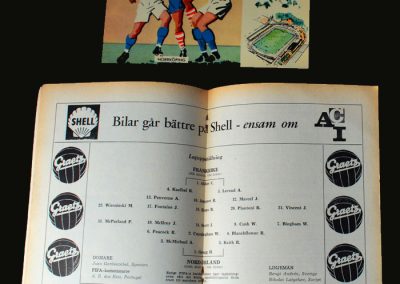
France v Northern Ireland 19.06.1958 (Quarter Final)
-
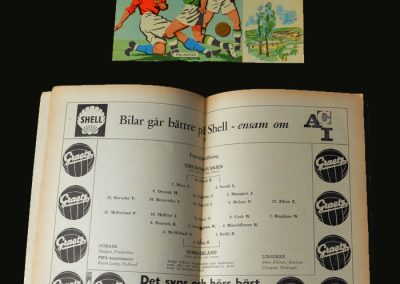
Northern Ireland v Czechoslovakia 17.06.1958
-

Northern Ireland v West Germany 15.06.1958
-
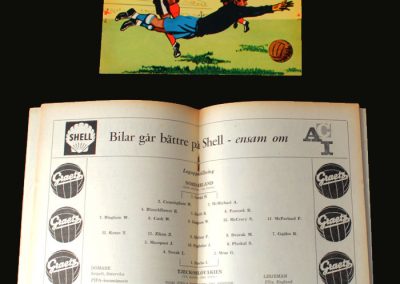
Northern Ireland v Czechoslovakia 08.06.1958


Sweden 1958 – Defying Expectations
Travelling to Sweden with just 17 players and limited financial support, Northern Ireland were drawn into an exceptionally tough group alongside West Germany, Argentina and Czechoslovakia. Few gave them any chance.
They began with a stunning 1–0 win over Czechoslovakia, Cush again providing the decisive goal. A 3–1 defeat to Argentina followed despite an early McParland strike, before a dramatic 2–2 draw with West Germany, in which McParland scored twice and Gregg delivered a heroic performance in goal.
A playoff against Czechoslovakia was required, and once again McParland rose to the occasion, scoring twice – including the winner in extra time – to send Northern Ireland into the quarter-finals.
There, injuries and exhaustion finally caught up with them. France, inspired by Just Fontaine, won 4–0. The journey ended, but the legacy was secured.
Gregg was voted the tournament’s best goalkeeper. McParland finished with five goals in five matches. For a small nation, it was an achievement of historic proportions.
For collectors today, the football programmes from these matches are tangible links to one of football’s great underdog stories – a campaign defined by courage, controversy and unforgettable moments.