
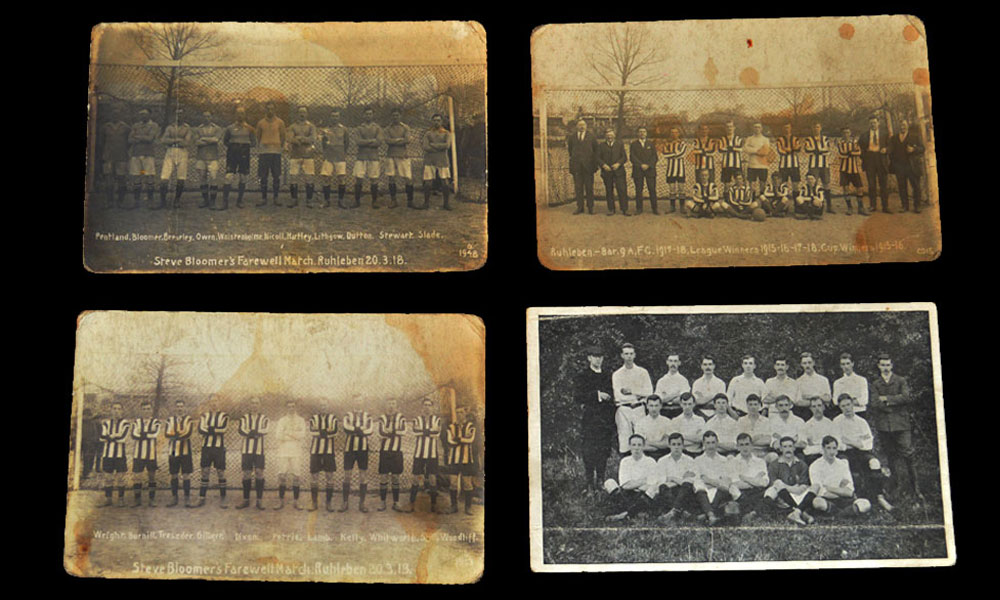
Ruhleben, March 1918
Steve Bloomer was the greatest footballer of his age—spanning 22 seasons from the late Victorian and Edwardian eras up to the start of the First World War. He scored 28 goals in 23 games for England at a time when they played only a handful of fixtures a year, and he became the Football League’s record goalscorer with 352 goals for Derby County and Middlesbrough, a mark that stood until Dixie Dean overhauled him in 1936. He was not just prolific; he was peerless, the ice-cool finisher whose name still echoes through football history.
After his playing career wound down, Bloomer took a coaching job in Berlin. This was a period when numerous British football men were spreading across Europe and beyond to teach the game. Their fingerprints can be found on the foundations of many modern clubs and even national sides. Jack Greenwell at Barcelona, Jimmy Hogan in Vienna and Budapest, and Fred Pentland—Bloomer’s former Middlesbrough colleague—on the continent are all part of that story. For once, though, Bloomer’s timing deserted him. He arrived in Berlin barely three weeks before war was declared in August 1914, and when hostilities began his contract was cancelled almost immediately.
Bloomer spoke no German. On 5–6 November 1914 he was detained as an enemy alien after his attempts to leave were frustrated—trains were requisitioned by the military, the British Embassy closed, and those of British nationality in Berlin were ordered to remain in place and report regularly to the police. As the war progressed and German policy hardened, enemy aliens were rounded up. In early November he was sent, with thousands of others, to Ruhleben internment camp, seven miles or so west of central Berlin.
Ruhleben was built around a pre-war harness racing track, its grandstand and stables adapted to house between 4,000 and 5,500 men. It was not a camp of industrialised brutality like those seen in the next conflict, but it was still a prison. Overcrowding was acute—hundreds slept in stalls designed for horses—food was meagre, and liberty was gone. Bloomer later said it was “food from home and sports” that kept men alive. That was no exaggeration. The internees organised themselves into a mini-society with schools, theatres and, crucially, sport.
Football quickly became the centrepiece. A Ruhleben Football Association was formed, with experienced professionals steering the organisation. Among the prisoners were a remarkable cluster of footballers: Bloomer; his England colleague Sam Wolstenholme; Pentland; Scotland international John Cameron; John Brearley, formerly of Everton and Spurs; and Edwin Dutton, German born to English parents. Cup and league competitions were arranged, lines marked out, and matches were played before crowds that sometimes swelled to a thousand in the makeshift stands. Teams adopted the names of established clubs, with Bloomer at various times captaining a “Tottenham Hotspur” XI assembled from the camp’s talent.
The football was far from frivolous. It was a structure for days that otherwise bled into one another—training, selection, fixtures, results, league tables. It provided exercise, rivalry, hope and routine. It forged community across class and profession. We know of big showpiece fixtures that lifted spirits, including a celebrated “England v The World” match in May 1915 on the camp’s pitch, which the internees nicknamed “The Oval”. The quality was high enough to draw spectators from the ranks of guards as well as prisoners.
Sport at Ruhleben didn’t end with football. In the summers they played cricket to packed “houses”, ran athletics meetings, and even held a quirky “Ruhleben Olympics”. Bloomer, naturally competitive, excelled there too—he set a camp batting record with a double century and took six wickets in an innings; he even won a sprint handicap. Yet it was with a ball at his feet that he mattered most. For young men fearing for their futures and for news from home, football was therapy, discipline and distraction all in one.
By 1918 the war had dragged on far longer than anyone expected when Bloomer was first detained. In those early weeks the British inmates had convinced themselves that Kitchener would “swipe the Jerries” and Jellicoe would smash their fleet, and that the whole thing would be over by Christmas. It was not. Bloomer remained in captivity for three and a half years. Over that time the camp’s self-help structures deepened, parcels from home became lifelines, and sport remained the heartbeat.
In March 1918, word came that Bloomer was to be released to neutral Holland. Before he left, the camp staged a final match in his honour—a farewell for the man whose name and deeds had animated so many of Ruhleben’s Saturdays. The game drew a large crowd of fellow prisoners, friends and acquaintances forged in the strangest of circumstances. Reports speak of a festive yet poignant occasion: a cup final atmosphere shadowed by goodbyes and uncertainty. Bloomer, lean and still sharp, took the field one last time within the barbed-wire arena where he had given people reason to cheer. Collections were taken; he received a benefit from grateful comrades. Then, like a star transferred in peacetime, he was gone—out through the gates to the Dutch border and on to Amsterdam, where he resumed coaching while the war still raged.
-
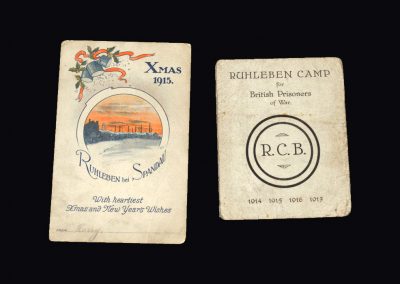
Ruhleben Camp Documents
-

Ruhleben Internment Camp Germany 20.03.1918 - for the english


Bloomer was not allowed to return to England until the Armistice. When he finally came home in November 1918, Derby welcomed back not just a football legend but a survivor who had used the game to save minds and morale. He would go on to be head coach of Derby County reserves and remain a revered figure in the city, his bust now a familiar sight to supporters. The Ruhleben years became a defining chapter in his story. “Myself and many others would not have survived without football,” he reflected. Those words have the weight of truth. On bare ground hemmed in by fences, ordinary fixtures became acts of endurance.
Two amazing books about Bloomer are available:
- Steve Bloomer: The Story of Football’s First Superstar
- The Ruhleben Football Association: How Steve Bloomer’s Footballers Survived a First World War Prison Camp
It is worth remembering that internment was a two-way reality in the Great War. Britain held large numbers of German and Austro-Hungarian civilians at camps such as Knockaloe on the Isle of Man. There, too, sport and cultural life helped prisoners endure their confinement, with football matches, clubs and committees built from scratch. On both sides of the North Sea, the world’s game was repurposed as a means to keep despair at bay.
So when we picture Steve Bloomer’s “final game” behind the wire at Ruhleben in March 1918, we should see more than a farewell friendly. We should imagine a community that had learned to cope, men who measured time in fixtures and seasons because the calendar offered little else. We should hear the hum of anticipation, the scrape of boots on cinders, the cheers that rose not only for goals but for the idea that, even in captivity, they were still players, still teammates, still themselves. And we should recognise the strange, beautiful truth that a sport born in English schoolyards helped sustain thousands of lives in a German prison camp.
In the interests of fair play english style, DT would confirm that the Brits had a camp full of interned germans at Knockaloe on the Isle of Man and some of their match line ups can be seen here. Sad to say that gritty little full back “a. hitler” was unavailable for selection.