
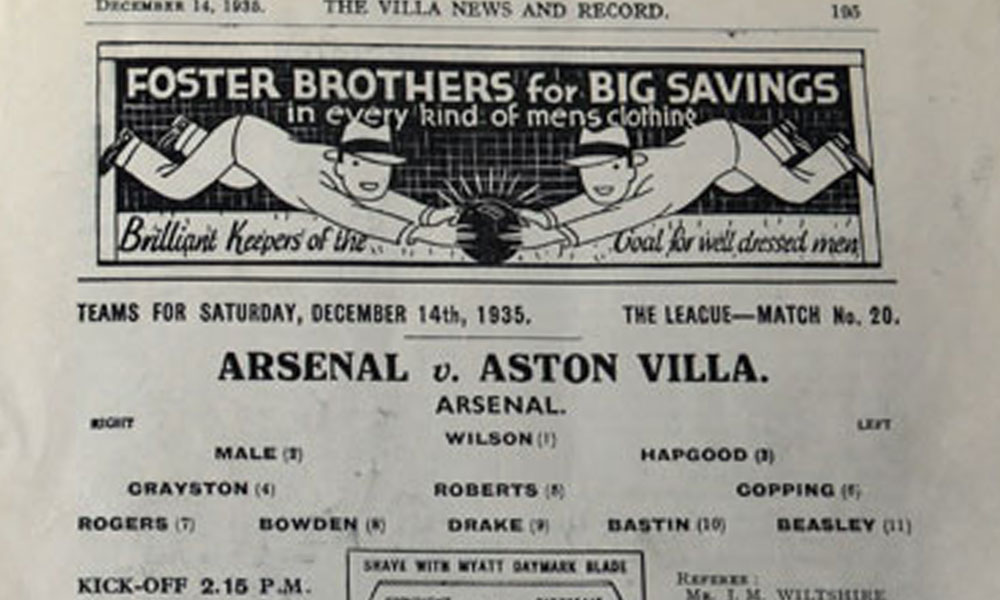
On 14 December 1935, Aston Villa hosted Arsenal at Villa Park in what, on paper, looked like a tough First Division fixture. Instead, it became one of the most extraordinary afternoons in English football history. Arsenal’s centre forward Ted Drake scored all seven goals in a 7–1 away win, setting a top-flight record that still stands today – and turning the match programme into a treasured piece of football history.
For collectors and historians alike, that flimsy piece of paper from a cold winter’s day in Birmingham is now a doorway back to an era of leather balls, heavy pitches and centre forwards built like brick walls.
The day Ted Drake ran riot
Drake’s haul was as clinical as it was relentless. He scored in the 15th, 28th and 34th minutes to give Arsenal a commanding half-time lead, then carried on after the break with goals on 46, 50, 58 and finally 88 minutes. In between his sixth and seventh, Villa’s John Palethorpe grabbed a consolation – his second goal against Arsenal that season, having already scored for Sheffield Wednesday earlier in the campaign.
Remarkably, Drake always insisted he should have had eight. One effort crashed off the bar, down onto the line and away; he was adamant it had crossed, but the officials waved play on. Even without the disputed strike, seven in a top-flight game away from home was (and remains) a freakish feat.
-

Arsenal v Aston Villa 14.12.1935 (7-1 win Drake scores all 7)
-

Brentford v Chelsea 05.10.1954 (Friendly) - manager Ted Drake delighted with his efforts in a couple of friendlies | Hull v Chelsea 11.10.1954 (Friendly)
-

Arsenal v Spurs 06.03.1935
-

Arsenal v Chelsea 06.04.1935


Playing through pain – and a different era
What makes the story even more remarkable is that Drake was playing hurt. He had injured his knee the day before and took the field with it strapped up. In today’s game, he might easily have been left out or substituted once the points were safe. Instead, he stayed on for the full 90, still thundering into challenges and making runs into the final minutes.
That was very much his style: powerful, direct and not afraid to put his body on the line. The price was a career littered with knocks. In 1938, playing against Brentford, he was badly injured and carried off unconscious over trainer Tom Whittaker’s shoulder. After coming round in the dressing room, he was bandaged up and sent back out for the second half, with a fresh wrap round his head and a dirty one round his damaged wrist. Only after the final whistle was he taken to hospital and kept in. It was a different footballing world.
The programme tribute hardly anyone saw
Back to 1935. A performance like that deserved to be immortalised in print, and Arsenal’s next home programme – for the scheduled match against Bolton Wanderers on 21 December – did exactly that. Under the headline “THE ASTON WONDER… DRAKE’S SEVEN,” the editor paid lavish tribute to their centre forward.
The piece noted how much Villa had actually pressed and how the real difference between the sides was that Arsenal had a “superman” in finishing, while Villa did not. It almost apologised for singling out an individual in a team game, but admitted that on this occasion it was “pardonable” because Drake had, in essence, decided the match on his own. Without him, the writer suggested, Arsenal were not six goals better than Villa at all.
The cruel twist is that the Bolton game was postponed due to a frozen pitch. That meant far fewer supporters ever saw the programme or read the tribute. For modern collectors, that postponement adds another layer of interest: both the Aston Villa v Arsenal programme and the postponed Arsenal v Bolton issue with its glowing write-up are now fascinating, complementary pieces of memorabilia.
A career of big moments
Drake’s seven-goal masterclass was no one-off. The following season he scored the only goal in the 1936 FA Cup Final, as Arsenal beat Sheffield United at Wembley. In an era packed with outstanding centre forwards, he also won England caps, underlining his status as one of the most feared number nines of the 1930s.
Wartime football and injuries eventually brought his playing career to an early end, but he did not disappear from the game. Instead, he moved into management and, in 1955, guided Chelsea to their first ever league title. For a man whose greatest day as a player came in Arsenal colours, it was quite something to carve his name into Chelsea’s history as well.
Programmes from those landmark moments – Villa Park in 1935, Wembley in 1936, Stamford Bridge in 1954/55 – chart the journey of a football life lived at full tilt.
“Cherish the memory, son” – and then eight goals
One of the most charming stories about Drake comes from his time at Chelsea, where a young Jimmy Greaves was emerging in the youth team. After Greaves scored seven in a game against Crystal Palace, Drake called him over.
“Do you know I once scored seven in a game, son?” he said. Greaves replied that he did know – every football-mad youngster did. As Drake told it, scoring seven was something reserved for a very select few, and it only came once in a lifetime. He urged Greaves to remember the feeling and to cherish it, because “that day will never come again”.
The punchline, of course, is that Greaves went out the following week and scored eight against Fulham.
It is a wonderful passing-of-the-torch moment: an old-school centre forward, battered by a lifetime of hard knocks, giving wise advice to a new kind of goalscoring genius. And yet it also underlines just how special Drake’s Villa Park performance was. Even in a game that produced freakish scoring feats, seven remained something to be treasured.
Why this story matters to collectors
For a site like 10footballs, these are exactly the stories that make football programmes so compelling. A programme is more than a list of names and adverts for cigarettes and razor blades; it is a frozen slice of football culture from a particular day.
The Aston Villa v Arsenal programme from 14 December 1935 captures a club on its way to another title, a famed stadium and a centre forward about to do something no one else has done in a top-flight game since. The postponed Arsenal v Bolton programme carries the club’s own immediate reaction, full of pride and admiration – but read by far fewer eyes than it deserved.
Put together, they offer a rich, tangible link to Ted Drake’s greatest afternoon and to an era of mud, heavy balls, minimal substitutions and maximum courage. For collectors, owning one of those football programmes is not just about having a rare item; it is about holding a story in your hands.
Nearly a century on, the numbers still leap off the page: Aston Villa 1, Arsenal 7, Drake (7). The match, the man and the programme remain a reminder that, sometimes, footballing immortality can be created in just 90 unforgettable minutes.