
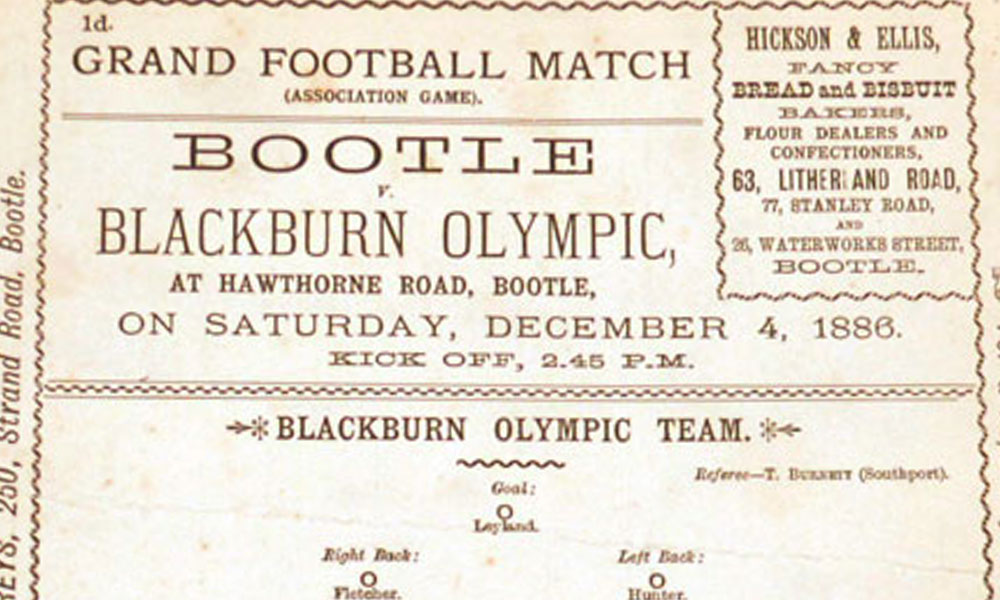
Football programmes sit in a brilliant sweet spot for collectors: they’re affordable enough to build a collection around, but rare enough that the right issue can become a genuine auction headline. The biggest prices tend to come from a perfect storm of age, survival rate, historic importance, and provenance (who owned it, where it’s been kept, and whether it can be verified).
If you’re hunting old football programmes or hoping to stumble across rare football programmes in a loft, a scrapbook, or a job lot, the auction records are a great guide to what the market truly prizes — and why.
Why some programmes become auction gold
Two programmes can look similar on the surface and end up worlds apart in value. The highest auction results usually share a few traits:
- Extreme scarcity: early football ephemera was never designed to last. Thin paper, single sheets, and matchday throwaways mean survival rates can be tiny.
- Historic “firsts”: inaugural finals, landmark trophy wins, or matches that changed the sport tend to carry a premium.
- A story you can’t separate from the item: tragedies, iconic teams, or culturally famous fixtures can turn a programme into a time capsule.
- Condition and completeness: covers, staples, and intact pages matter, but rarity can outweigh flaws.
- Provenance: a traceable history (especially from a known collection) increases confidence — and bidding.
The world-record programme: 1882 FA Cup Final — £35,250
The benchmark sale for a football programme is still the earliest known surviving FA Cup final programme: Old Etonians v Blackburn Rovers (25 March 1882). It sold at Sotheby’s in London for £35,250 — a record figure for a programme.
Why is it so famous? It’s not about star players or a glamorous scoreline. It’s famous because it’s foundational: an FA Cup final programme from the Victorian era, tied to the early identity of organised football, and rare enough to be museum-worthy. In practical collecting terms, it proves one thing clearly: when survival numbers are microscopic, bidders will stretch far beyond what most people expect a “bit of paper” to achieve.
A £20,000 slice of Albion history: 1886 FA Cup Final — £20,000
Another standout is the 1886 FA Cup Final programme (West Bromwich Albion v Blackburn Rovers). This one reached £20,000 at auction.
The appeal here is a mix of age + scarcity + significance. Programmes from the 1880s are incredibly hard to find in any condition, and FA Cup finals sit at the top of the pyramid for British football memorabilia. Add the fact that it represents a major early milestone for a storied club, and you’ve got a piece collectors chase aggressively when it appears.
The Invincibles era in print: 1889 FA Cup Final — £19,000
The 1889 FA Cup Final (Preston North End v Wolverhampton Wanderers) has also posted a massive result: £19,000 at auction (reported in the trade press as a record at the time).
This is the programme that connects directly to one of the sport’s great historic narratives: Preston’s “Invincibles” season and early dominance. For collectors, it ticks two powerful boxes at once — it’s an FA Cup final programme from football’s early years, and it’s attached to a widely repeated, easily understood story. That clarity of story matters, because auctions reward items bidders can instantly place in football history.
A non-league legend: 1901 FA Cup Final — £12,500
Fast-forward a little and you find a result that still makes collectors’ eyebrows lift: an 1901 FA Cup Final programme (Tottenham Hotspur v Sheffield United) that sold at £12,500.
It’s famous because Spurs remain one of the most-discussed historical exceptions: the only non-league club to win the FA Cup after the Football League’s formation. The match itself is part of the myth-making of the competition — huge crowd, heavyweight story, and an era when surviving paper is far from guaranteed.
Manchester United’s first FA Cup win: 1909 souvenir programme — £8,500
A more recent headline (and a brilliant example of how club history drives prices) is the 1909 FA Cup Final souvenir programme for Manchester United v Bristol City, which sold for £8,500.
This is famous because it captures a genuine “first”: United’s first FA Cup triumph. Collectors love firsts, and big-club firsts can be especially fierce at auction because multiple groups want them — United specialists, FA Cup collectors, and general football historians.
The “only surviving” factor: 1908 FA Cup Final — £4,800
Sometimes a programme becomes famous less for the match and more for its survival story. A programme from the 1908 FA Cup Final (Wolverhampton Wanderers v Newcastle United) was reported as believed to be the only surviving example and sold for £4,800 (including premium).
That “only surviving” phrase is rocket fuel in an auction catalogue. Even if you’re not a Wolves or Newcastle collector, scarcity at that level turns the item into a once-in-a-generation opportunity — and bidders behave accordingly.
When tragedy changes everything: the Munich air disaster postponement — £7,500 hammer
Not all valuable programmes are century-old cup finals. One of the most striking modern examples is a Manchester United v Wolverhampton Wanderers programme for a match scheduled just after the Munich air disaster. With many copies destroyed, one example sold for a £7,500 hammer price (total paid £9,840 including buyer’s premium).
This is famous for obvious reasons: it’s directly tied to a moment of profound loss in football. Collectors often describe items like this as memorial pieces as much as memorabilia — and that emotional gravity can be reflected in the bidding.
A reality check: iconic doesn’t always mean expensive (1966 World Cup Final)
It’s worth noting that some of the most famous matches in football history produced programmes that are widely available. For example, an England v West Germany 1966 World Cup Final match programme (even signed) can sell for far less than people assume — sometimes in the low hundreds depending on condition and details.
That doesn’t make them poor collectibles — it just underlines a key rule: auction value follows rarity and survivability more than fame alone.
What to look for if you’re hunting valuable programmes
If you’re collecting old football programmes with an eye on long-term value, keep a simple checklist:
- Pre-war and early cup finals: age plus significance is hard to beat.
- Single-sheet or thin issues: they’re more likely to have been binned, so survivors can be scarce.
- Abandoned/postponed matches: especially those linked to major events, disasters, or historic disruptions.
- Provenance clues: letters, envelopes, ticket stubs, or a consistent collection history can help.
- Be honest about condition: don’t “restore” unless a specialist advises it — originality is often prized.
Programmes are one of the most satisfying corners of football collecting because every issue is a snapshot: teams, adverts, venues, even the language of the time. The auctions show that when a programme represents a true landmark — and when very few have survived — it can become far more than matchday reading. It becomes football history you can hold.