

A great centre-forward remembered through print
Tommy Lawton is one of those footballers whose reputation still feels larger than time. He belongs to an earlier age of the game, yet his name still carries weight with anyone who knows football history. Powerful, brave, brilliant in the air and fiercely individual, he was one of England’s most celebrated centre-forwards. While many supporters know his name from goalscoring records and old photographs, collectors have another way to follow his life in football: through the programmes that marked his journey.
That is what makes a football programme collection so rewarding. It is not just about preserving fixtures or keeping souvenirs. It is about tracing a career through the original printed material of the day. In Tommy Lawton’s case, old football programmes allow collectors to follow the rise of a young star, the interruption of war, the return of the great goalscorer, and the later chapters that made his story even more distinctive. His programme trail is rich, varied and full of character, which makes him a superb subject for anyone interested in the history of the game.
Burnley beginnings and the move to Everton
As with so many important footballing stories, Lawton’s programme trail begins before he was fully established. Early material linked to Burnley has a special charm because it captures him in the first stage of his senior career, before he became a national figure. These are the sorts of items that often become more interesting with time. What may once have looked like a straightforward league programme can later be seen as the starting point of an exceptional career.
The move to Everton is where the collecting story really gathers pace. Lawton joined the club as a teenager and quickly emerged as a major force. Everton programmes from the late 1930s are especially attractive because they belong to a period when he was developing into one of the finest centre-forwards in England. For collectors of old football programmes, that sense of emergence matters. A programme tied to the early years of a star often carries a certain excitement, because it captures the moment before legend has fully formed.
In Lawton’s case, Everton material has added appeal because it links him to a powerful side and to the years in which he established his reputation at the highest level of the English game.
Championship football and a pre-war peak
Lawton’s Everton years are central to any serious football programme collection focused on him. This was the stage at which he became not just a promising forward but one of the outstanding attacking players of his generation. Programmes from league fixtures, major cup ties and important home games all help to tell that story.
There is a particular appeal in programmes from the late 1930s because they sit so close to Lawton’s pre-war peak. These issues belong to an era when football still had a distinctive printed culture: elegant covers, detailed club notes and a strong sense of occasion. To collect them now is to hold a small piece of the world in which Lawton made his name.
Rare football memorabilia often draws attention, but there is something especially satisfying about old football programmes because they preserve context as well as fame. With Lawton, they do not simply tell you that he was admired. They show the setting in which he was admired, week after week, by supporters following one of the most feared forwards in the country.
-

Aldershot v Southampton 27.11.1943 10-1 Lawton 6.
-
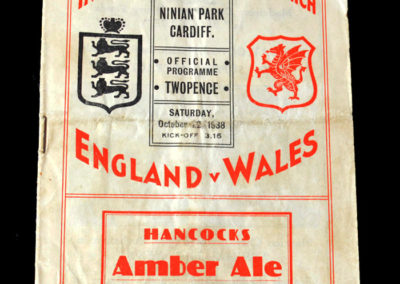
England v Wales 22.10.1938 Tommy Lawton debut
-
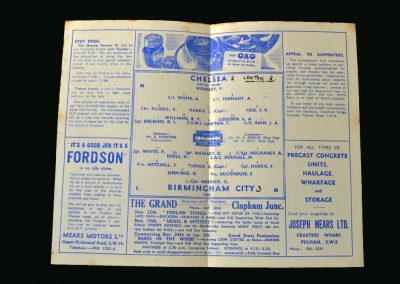
Chelsea v Birmingham 10.11.1945 (Lawton Debut)
-

Kettering v Peterborough 29.04.1957 - Maunsell Cup Final (Lawtons last goal)


England programmes and the mark of a great goalscorer
International programmes are another essential part of Lawton’s story. His England career gives collectors an opportunity to look beyond club football and see how highly he was valued on the national stage. For many players, international issues are a useful addition to a collection. For Lawton, they are absolutely central.
England programmes linked to his appearances help underline how prolific and important he was. They also broaden the collection visually and historically. The tone of an England programme is different from that of a club issue, and that contrast makes a football programme collection more interesting. In Lawton’s case, international material reflects a footballer who was trusted to lead the line for his country and who delivered goals at an exceptional rate.
For collectors, this makes England appearances one of the strongest sections in any Lawton-themed collection. They add prestige, variety and a wider sense of importance to the printed record of his career.
War, interruption and unusual collecting interest
One of the reasons Tommy Lawton is such an interesting figure in programme terms is that his career was shaped by the Second World War. Like so many players of his era, years that should have been among his very best were disrupted by conflict. That interruption changes the nature of the collecting trail and gives it a different texture from that of players whose careers ran uninterrupted.
Wartime programmes, guest appearances and transitional post-war issues all add historical depth. They remind collectors that football history is never sealed off from the wider world. In Lawton’s case, the war years do not weaken the collecting story. They enrich it, because they add another layer of rarity, context and emotional weight.
A football programme collection built around him can therefore cover not just peacetime league football and internationals, but also the unusual and sometimes overlooked material from wartime football, which helps make his story feel broader and more human.
Chelsea, Notts County and the surprise turns
If Lawton had only starred for Everton and England, he would still be a major figure for collectors. What makes him even more compelling is the way his career kept moving into unexpected places. His spell at Chelsea provides one such chapter, and programmes from that period add another layer to the printed story of his football life.
Then comes one of the most striking turns of all: the move to Notts County. For collectors, this is a fascinating chapter because it combines celebrity with surprise. A centre-forward of Lawton’s standing joining a lower-division club gives those programmes an immediate pull. They are not merely routine matchday items. They represent one of the most talked-about moves of the time.
Notts County programmes linked to his debut, early home appearances and the years that followed are especially evocative. They show how a famous footballer could transform the profile of a club and energise supporters simply by arriving. This is exactly the sort of chapter that makes a football programme collection feel alive, because it reflects drama, ambition and a sense that the game could still take unexpected turns.
Later years and the full collecting journey
Lawton’s later career, including his spells with Brentford, Arsenal and Kettering Town, gives collectors even more ground to cover. These are not always the first programmes that come to mind when people think of his name, but that is part of their appeal. They complete the story.
A great player’s legacy is not made only of peak years. It is also shaped by the closing chapters, the final appearances and the unexpected clubs that become part of the wider narrative. For collectors of old football programmes, these later issues often carry a reflective quality. They show a famous player in a new context, sometimes still commanding attention, sometimes already becoming a figure of nostalgia.
With Lawton, that broad range of clubs and occasions means a collector can build a wonderfully varied football programme collection around him, from top-flight fame to later-career curiosity.
Why Tommy Lawton remains a superb subject for collectors
Tommy Lawton remains such an attractive figure for collectors because his career offers everything that makes football programmes worth preserving. There is youthful promise, great goalscoring, England recognition, wartime disruption, major transfers and an unusually wide spread of clubs and contexts. Few players offer such a complete printed journey.
That is why he matters so much in the world of football collecting. A Tommy Lawton collection is not just a set of matchday publications. It is a portrait of one of England’s great centre-forwards told through the paper history of the game. For anyone drawn to old football programmes and the pleasure of building a meaningful football programme collection, Lawton remains one of the finest names to follow.