

A football genius preserved in print
For anyone interested in football history, George Best remains one of the most fascinating figures the game has ever produced. He was dazzling, unpredictable, charismatic and, at his peak, almost unplayable. His story is usually told through goals, photographs and famous quotes, but for collectors there is another way to follow his career: through the programmes that marked each step along the way.
That is one of the great joys of a football programme collection. It does not simply preserve a club’s fixtures. It preserves a player’s rise, his moments of brilliance, his changing reputation and, in Best’s case, the extraordinary contrast between youthful promise and global stardom. Old football programmes connected to George Best are more than memorabilia. They are printed snapshots of one of football’s most gifted and compelling lives.
From promising youngster to first-team debut
George Best’s story in programmes begins before he was a household name. That is what makes collecting his material so interesting. The earliest items are not grand finals or famous European nights, but youth and reserve fixtures, the sort of programmes that only later take on a special significance when a future legend emerges from the pages.
For collectors, these early issues are a reminder that greatness often starts quietly. Youth matches, reserve games and lesser-known fixtures can become essential parts of a football programme collection because they show the build-up to a major career. With Best, that journey includes youth football, reserve football and then the key stepping stone of his senior debut for Manchester United.
The programme for Manchester United v West Bromwich Albion in September 1963 holds a special place in the story. Best was only 17 when he made his first-team bow. That single issue now represents the beginning of a career that would change the image of football in the 1960s. For collectors of old football programmes, debut matches always carry a special attraction, but when the debut belongs to George Best, the appeal is even stronger.
The rise of a superstar at Manchester United
Once Best established himself in the Manchester United side, the programmes become a running record of his growth from exciting young winger into one of the biggest stars in world football. Early league programmes, cup ties and European fixtures chart not only his appearances but also the growing sense that supporters were watching someone different.
By the mid-1960s, Best was no longer a promising youngster. He was becoming the player people turned up to see. Manchester United programmes from this period reflect the scale of the club, the glamour of the era and the excitement around a team packed with famous names. Yet Best often stands out as the central figure because he brought something unique: flair mixed with end product, showmanship mixed with genuine match-winning ability.
For those building a football programme collection, this is the stage where the material becomes especially rich. Home league matches, FA Cup ties and European fixtures all form part of the narrative. A programme is never just about the final score. It is about the cover design, the editorial tone, the adverts, the line-ups and the atmosphere of the moment. Through Best’s Manchester United years, old football programmes capture the sense of a player turning into an icon in real time.
-

Benfica v Man Utd 09.03.1966 (European Cup Quarter Final 5-1 win)
-

Man Utd v Partizan Belgrade 20.04.1966 - European Cup Semi Final 2nd Leg
-
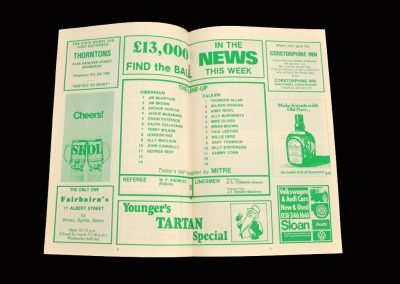
Hibs v Falkirk 11.10.1980 - Best's last game
-

Edmonton v Portland 12.05.1981 (Best on cover)


The Benfica night and the European peak
Every legendary footballer has certain matches that define how history remembers them. For George Best, one of the most important was the European Cup quarter-final against Benfica in 1966, when he announced himself to a wider audience in spectacular fashion. A programme from that tie is not just an item from a major European match. It represents the night Best became an international football sensation.
From there, the trail leads to the absolute summit of his career in 1968. Programmes from the European Cup run, especially the semi-final against Real Madrid and the final against Benfica at Wembley, are among the most evocative of all George Best items. These are the programmes that connect directly to his greatest team achievement and to the year in which he became European Footballer of the Year.
The 1968 European Cup Final programme is one of the standout pieces in any football programme collection focused on Best or Manchester United. It combines a famous occasion, one of the most celebrated sides in English football history and a defining performance from a player at his peak. It is exactly the kind of issue that collectors of old football programmes treasure because it sits at the intersection of rarity, importance and emotion.
International programmes and another side of Best
George Best’s club career always receives the most attention, but international programmes add another valuable dimension to his story. Northern Ireland appearances matter because they show a different setting for his talent. These programmes connect him not to the glamour of Old Trafford and European Cup nights, but to national pride and the challenge of carrying a smaller footballing nation.
For collectors, international issues often have a slightly different feel from club programmes. The design, tone and context can all shift. In Best’s case, they help round out the picture of the footballer. He was not just Manchester United’s great entertainer. He was also Northern Ireland’s greatest individual talent, and programmes from those matches help preserve that part of his legacy.
That is why a well-chosen football programme collection should not focus only on the biggest club occasions. It should also include the international matches, the qualifiers, the British Championship ties and the less obvious issues that tell the fuller story.
The later years and the enduring appeal
One reason George Best remains such a compelling subject for collectors is that his programme story does not end with glory. It keeps going through later clubs, comeback attempts and unexpected chapters. That longer trail gives collectors far more to explore than just the famous Manchester United years.
Issues linked to clubs such as Stockport County, Fulham, Hibernian and others offer a completely different perspective. They show the wandering, restless second act of a player whose fame never disappeared, even as his peak years slipped behind him. In collecting terms, that makes Best especially interesting. His programmes cover brilliance, celebrity, decline and nostalgia all at once.
There is something deeply human in that. A football programme collection built around George Best is not only about honours and headlines. It is about the full arc of a football life. The early promise, the unforgettable peak and the later chapters all survive in print.
Why George Best remains essential for collectors
George Best and football programmes are a perfect match because both stir memory so powerfully. He was a player who made people feel that anything could happen when he received the ball. Programmes do something similar for collectors. They bring back the texture of football’s past and allow us to hold a small part of it in our hands.
For anyone interested in old football programmes, Best offers one of the richest collecting themes in the game. From youth fixtures and debut issues to European Cup glory, internationals and later-career curiosities, the material is varied, emotional and steeped in history. That is why George Best remains such an important figure in any serious football programme collection: not just because he was great, but because his life as a footballer is so vividly preserved in programmes.