
International football tournament programmes have a different kind of appeal from club issues. A league match programme belongs to a season. A cup final programme belongs to one great domestic day. But a European Championship programme belongs to a whole summer of expectation, travel, colour and national drama. For collectors, that makes Euro issues a fascinating corner of the hobby, especially when the tournament’s long history stretches from the tiny four-team finals of the early years to the much larger and more theatrical competitions we know today. The European Championship began in 1960, expanded to eight finalists in 1980, then to 16 in 1996 and 24 in 2016, and each phase of that growth changed the look, feel and collecting appeal of its programmes.
For anyone interested in old football programmes, Euro tournament issues offer more than just nostalgia. They capture shifts in football culture, graphic design, sponsorship, host-nation identity and the changing scale of the competition itself. Some are modest and elegant, shaped by an era when international tournaments felt smaller and more formal. Others are bold, glossy and unmistakably modern. Across every era, though, the best examples hold the same attraction: they take you back to a specific tournament and the mood that surrounded it.
The charm of the early tournaments
The earliest European Championship programmes have a special place because the competition itself was still finding its identity. Up to and including 1976, the finals involved only four sides, which meant that merely reaching the tournament placed a nation straight into the semi-finals. That format makes the surviving programmes from those years feel especially concentrated and significant, because every issue is tied to a decisive stage of the competition.
These early editions often appeal to collectors because of their relative simplicity. The covers and layouts can feel restrained compared with later tournament material, but that is part of their charm. They belong to a period when international football still carried a formal, almost ceremonial air. For collectors of rare football programmes, this is often where the fascination deepens. The fewer matches there were, the fewer official issues there tended to be, and that naturally increases desirability.
The 1968 tournament is a particularly interesting marker because it was the first edition staged after the competition had been rebranded as the European Championship in the form we now recognise. Italy hosted and won, and the tournament sits neatly between the earliest pioneering years and the more developed eras that followed.
Eight teams and a broader stage
Euro 1980 is one of the major turning points in programme collecting because it was the first final tournament to feature eight teams. That gave the championship a broader feel and increased the range of official material linked to the event. More teams meant more fixtures, more host-city identity and more scope for collectors to pursue a fuller tournament run rather than only a handful of semi-final and final issues.
This is often where Euro collecting starts to feel more expansive. Instead of only chasing the biggest headline matches, collectors can also enjoy the smaller details of group-stage football, early tournament expectations and the distinct flavour of a host nation trying to present itself on an international stage. For some, that is where the real pleasure lies. A programme from a less glamorous group match can still be a wonderful object if it carries the look and feel of a memorable tournament.
Classic matches and surprise stories also help lift specific issues beyond the ordinary. That is true throughout Euro history, but the eight-team era opened the door to more variety in the collecting field.
Euro 1996 and the tournament modernises
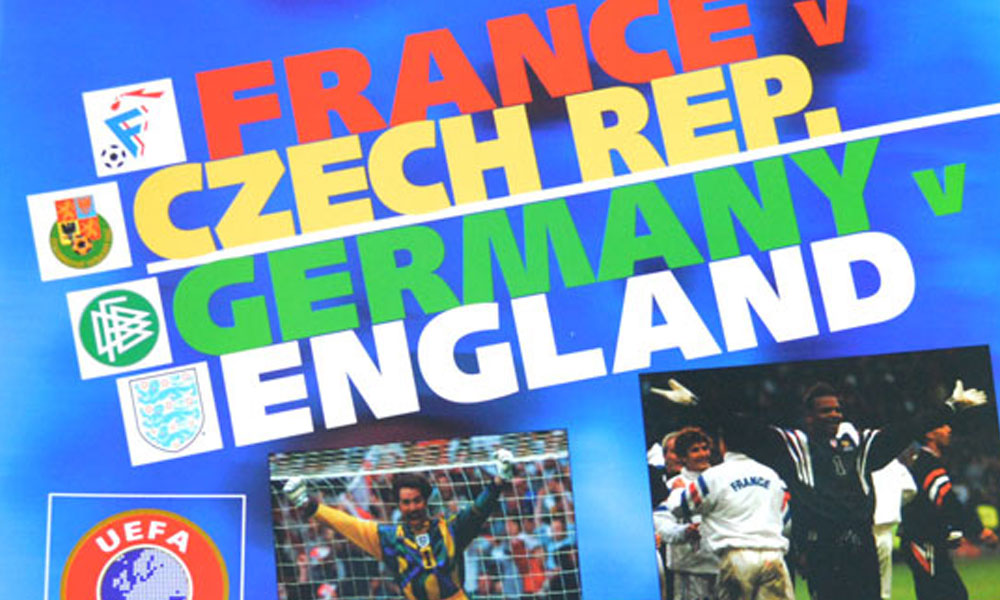
For many British collectors, Euro 1996 has obvious emotional pull. It was the first tournament to feature 16 finalists, and it arrived wrapped in atmosphere, colour and a sense that the competition had stepped into a more modern age. UEFA notes that 16 teams featured for the first time at that tournament, with six countries making their final-tournament debuts.
Programmes from Euro 1996 often attract collectors because they sit at a sweet spot between old and new. They are modern enough to feel polished and tournament-led, but still close enough to an earlier football culture to carry warmth and character. Add in the drama of England’s run, Germany’s eventual triumph and the golden-goal final, and it is easy to see why issues from that summer remain so collectible.
A classic tournament usually creates classic programmes almost by default. When supporters remember the football vividly, the printed material associated with it gains an extra layer of meaning.
-

Czech Rep v Germany 30.06.1996 Final
-

England v Scotland 15.06.1996
-

England v Netherlands 18.06.1996
-

France v Netherlands 22.06.1996 | England v Spain 22.06.1996


The 24-team era and new kinds of collectability
When the tournament expanded again for Euro 2016, it moved to a 24-team format for the first time. UEFA also highlighted that expansion as a major shift in the structure and scale of the finals, and it changed the collecting landscape once again.
With more teams, more matches and more host-city identity, modern Euro programme collecting can become broader and more thematic. Some collectors focus on complete runs from one tournament. Others chase knockout-stage issues only. Some go after matches linked to shocks, giant-killings or surprise winners. Portugal’s title in 2016 is a good example of how an unexpected path to victory can elevate tournament material afterwards, especially when the winner did not dominate in the usual way. UEFA noted that Portugal became champions after progressing as one of the best third-placed teams under the expanded format.
That kind of story matters in collecting. Surprise winners, unexpected finalists and improbable runs tend to give programmes a stronger afterlife.
What makes a Euro programme genuinely desirable?
Not every tournament programme becomes a trophy piece. Some are common, some are tied to forgettable matches and some simply lack the visual spark or historical weight collectors tend to chase. The most desirable Euro issues usually have a combination of qualities.
First, there is significance. Programmes linked to firsts, finals, famous shocks or major turning points in the competition always stand out. Second, there is memory. A match that remains vivid in football culture gives its programme a stronger pull. Third, there is scarcity. Older tournament material, especially from the early eras, naturally becomes harder to find in strong condition.
Design matters too. A beautiful cover, distinctive host-nation branding or an issue that immediately evokes a particular football summer can all make the difference. That is one reason tournament collecting has such lasting appeal. The programme is not merely a record of who played whom. It is a souvenir of how the tournament wanted to present itself to the world.
Why Euro programmes belong in any serious collection
Collectors of old football programmes often begin with club football, cup finals or home-team issues. But European Championship programmes offer something a little different. They combine football history with travel, design and the changing story of the international game. From the early four-team years to the larger modern finals, they show how the tournament grew in scale and confidence across the decades.
That makes them rewarding whether you are hunting rare football programmes from the earliest editions or building a more personal collection around tournaments you remember best. Some collectors will chase finals, others semi-finals, others complete tournament sets from favourite summers. There is no single right route in.
What matters is that these programmes preserve the atmosphere of the Euros in a way results alone never can. They hold the artwork, typography, host-city style and sense of occasion that surrounded the football. In that sense, the best Euro programmes do more than record history. They let you hold a piece of a football summer in your hands.