
The 1960s transformed British football. It was a decade of packed terraces, famous cup runs, European adventures and England’s greatest international triumph. The game became more ambitious and more colourful, and the football programmes produced during the period recorded every stage of that change.
For collectors, programmes from the 1960s offer much more than team sheets and match reports. Their covers, advertisements, photographs and editorial features reveal how football was moving from its traditional post-war identity towards the increasingly commercial and international game that emerged in the 1970s.
A New Look for the Matchday Programme
Many football programmes from the early 1960s retained the simple appearance of the previous decade. Covers often featured club colours, crests, fixture details and little else. Printing was economical, paper quality varied and photographs were commonly reproduced in black and white.
As the decade progressed, however, programme design became more adventurous. Stronger typography, illustrated covers and brighter colour combinations began to appear. Some clubs introduced action photographs, player portraits and more recognisable visual identities.
These changes reflected developments beyond football. Colour printing was becoming more accessible, advertising was growing in importance and clubs were beginning to understand that a programme could be both an information guide and an attractive souvenir.
Collectors can trace this evolution by comparing issues from the beginning and end of the decade. A modest league programme from 1960 may look functional and restrained, while an issue from 1969 can feel far closer to a small magazine.
Tottenham’s Double and First European Triumph
Tottenham Hotspur helped define the opening years of the decade. Bill Nicholson’s side won the League and FA Cup Double in 1960–61, becoming the first English club to achieve the feat during the twentieth century.
Programmes from that season are essential items for anyone interested in football history. Home and away issues document a campaign featuring players such as Danny Blanchflower, Dave Mackay, Cliff Jones and Bobby Smith. The 1961 FA Cup Final programme, produced for Tottenham’s victory over Leicester City, provides the natural centrepiece of a collection devoted to the Double.
Tottenham then carried English football further into Europe. Their 5–1 victory over Atlético Madrid in the 1963 European Cup Winners’ Cup final made them the first British club to win a major European trophy. The final programme represents a landmark moment when continental competition began to occupy a much larger place in the imagination of British supporters.
West Ham and Liverpool Go Abroad
European competition became one of the decade’s defining themes. Floodlit matches against unfamiliar opponents offered something different from the weekly League programme. Foreign names, international advertisements and bilingual content gave many European issues a distinctive atmosphere.
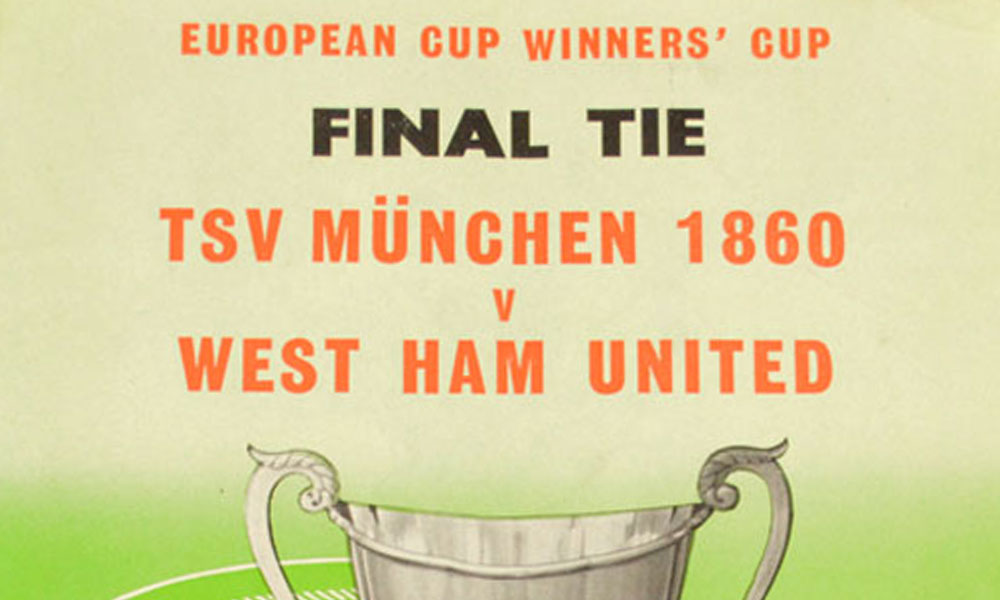
West Ham United’s 1965 European Cup Winners’ Cup final against 1860 Munich is one of the period’s most appealing programmes. Played at Wembley, the match ended in a 2–0 West Ham victory, with Alan Sealey scoring both goals. The programme recalls a celebrated side containing Bobby Moore, Geoff Hurst and Martin Peters, all of whom would play important roles for England the following year.
Liverpool’s first great European campaigns also belong firmly to this era. Programmes from matches against Inter Milan, Celtic and Borussia Dortmund illustrate the club’s rise under Bill Shankly. Liverpool lost the 1966 Cup Winners’ Cup final to Dortmund at Hampden Park, but the programme remains significant as a record of the club’s first European final.
-
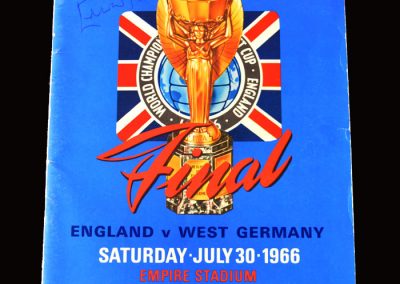
England v West Germany 30.07.1966 - World Cup Final
-

West Ham United v TSV Munchen 1860 | 19.05.1965 | European Cup Winners' Cup Final
-

Leicester v Man City 26.04.1969 - FA Cup Final
-

Man Utd v Real Madrid 24.04.1968 / 15.05.1968 (European Cup Semi Final)


The Programme That Defines 1966
No collection of 1960s football programmes feels complete without an issue connected to the 1966 World Cup. The tournament brought international football to grounds across England and produced programmes for group matches, knockout ties and the final itself.
The England versus West Germany final programme is undoubtedly the most recognisable issue of the decade. England’s 4–2 victory after extra time, Geoff Hurst’s hat-trick and Bobby Moore lifting the Jules Rimet Trophy have become central images in English football history.
Although original final programmes are collectable, they are not necessarily rare. Large numbers were produced, and reprints have also circulated for many years. Condition, authenticity, writing, team changes and additional documentation can all affect desirability.
Collectors may also look beyond the final. Programmes from England’s matches against Argentina and Portugal, North Korea’s famous victory over Italy and Portugal’s dramatic quarter-final comeback against North Korea all tell important parts of the tournament’s story.
Manchester United Conquer Europe
Manchester United’s victory in the 1968 European Cup final was another decisive moment. Ten years after the Munich air disaster, Matt Busby’s side defeated Benfica 4–1 after extra time at Wembley.
The final programme is one of the essential football programmes of the 1960s. It combines sporting importance with an emotional story recognised far beyond Old Trafford. George Best, Bobby Charlton and Brian Kidd scored the goals that made United the first English winners of the European Cup.
Programmes from earlier rounds can make an equally rewarding collection. Issues covering United’s ties against Hibernians, Sarajevo, Górnik Zabrze and Real Madrid allow collectors to follow the entire journey rather than focusing only on the final.
Crowds, Terraces and Changing Football Culture
The decade’s programmes also capture the experience of attending football before all-seater stadiums, digital scoreboards and online ticketing. Large crowds stood on open terraces, floodlights created dramatic evening atmospheres and printed programmes provided information that supporters could not obtain instantly elsewhere.
Inside, readers found manager’s notes, player profiles, reserve-team reports, supporters’ club news and advertisements for local businesses. Some programmes contained detailed statistics, while others relied on brief notes and plenty of advertising.
These details make ordinary league issues valuable pieces of social history. Prices for cars, cigarettes, clothing, holidays and household goods place each match within the wider world of 1960s Britain.
Specific Programmes That Define the Decade
A focused collection might begin with the 1961 FA Cup Final, Tottenham’s 1963 European Cup Winners’ Cup final, West Ham’s 1965 European triumph and Liverpool’s 1966 meeting with Borussia Dortmund.
The 1966 World Cup final and Manchester United’s 1968 European Cup final provide two obvious centrepieces. Other significant choices include Celtic’s 1967 European Cup final victory, Leeds United’s 1968 Inter-Cities Fairs Cup success and Newcastle United’s triumph in the same competition in 1969.
Together, these football programmes show how quickly the sport expanded during the decade. Domestic success remained important, but British clubs were increasingly measuring themselves against Europe’s finest.
Printed Records of a Football Revolution
Programmes from the 1960s preserve a game caught between tradition and modernity. Early issues recall the straightforward designs and local character of post-war football, while later examples feature brighter covers, greater ambition and a growing awareness of football’s international appeal.
From Tottenham’s Double to England’s World Cup victory and Manchester United’s European Cup success, the decade supplied countless landmark occasions. Collecting their programmes creates a paper timeline of one of the most important periods in football history – an era when English football looked confidently towards Europe while enjoying its greatest moment on the world stage.