
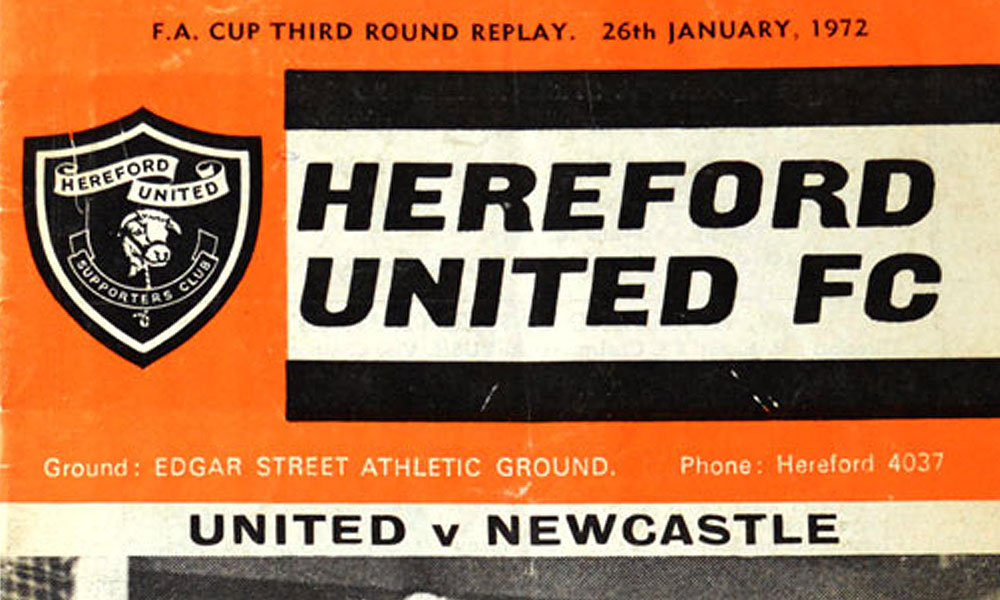
The FA Cup has always promised the possibility of the impossible. That is why it still occupies such a special place in football history. League form, budgets and reputation can all suggest one outcome, only for a smaller club to rip up the script in front of a packed ground and an expectant crowd. For supporters, those moments live forever in memory. For collectors, they also live on in the programmes issued on the day.
A programme from a giant-killing is never just a match souvenir. It becomes a witness to shock, disbelief and a sudden rewriting of football hierarchy. What may have looked like an ordinary issue before kick-off can turn, by full-time, into a treasured artefact. That is one reason football programmes linked to famous upsets often become some of the most cherished pieces in any football programme collection. They do not simply record a fixture. They preserve the exact moment when the smaller club refused to behave like the smaller club.
Why upset programmes carry such special appeal
Collectors are often drawn to finals, title deciders and great European nights, but giant-killing programmes offer something a little different. They carry surprise. They belong to matches that were not supposed to become historic. That gives them an added charm. A cup final programme is printed for an occasion everyone already knows is important. A giant-killing programme becomes important because of what happens afterwards.
That transformation is central to their appeal. A lower-league or non-league club might produce a fairly modest issue compared with the polished programme of a major club, yet if that small side goes on to stun famous opposition, the programme’s status changes completely. It becomes part of the story of the Cup itself. The simpler the ground, the greater the contrast, and often the greater the romance. For anyone interested in football history, these issues capture the point where paper and legend meet.
Hereford United v Newcastle United, 1972
No discussion of Cup shocks can begin anywhere else. Hereford United’s 2-1 replay win over Newcastle United in February 1972 remains one of the defining giant-killings in English football. The FA still presents it as one of the great classic upsets, with Ronnie Radford’s equaliser on a mud-soaked Edgar Street pitch sitting at the heart of the competition’s mythology.
For collectors, the programme from that tie has become far more than a non-league issue from the early 1970s. It represents the giant-killing in its purest form: a non-league side, a top-flight opponent, dreadful conditions, a famous goal and a result that entered folklore. This is exactly the kind of programme that rises from local souvenir to national treasure. Even people who do not collect Hereford material know the match. That broad recognition always strengthens an issue’s place in the hobby.
-

Hereford v Newcastle 05.02.1972 - postponed from 26.01.1972
-

Hereford v Newcastle 26.01.1972 | Hereford v Newcastle 05.02.1972 - Ticket
-

Hereford v Newcastle 15.01.1972 3rd Round 2-2 - An opening goal for Hereford after 17 seconds. A "Catalogue of near misses by Newcastle" and "The aristocrats of the first division were humiliated by a bunch of part timers from the obscurity of the southern league" (to be fair they were top of that league and soon to be elevated to the fourth division)
-
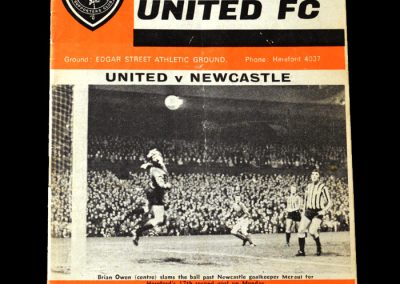
Hereford v Newcastle - 3rd Round Replay 05.02.1972 2-1 - 2-1 John Motson & Ronnie Radford go into FA Cup folklore before sub Ricky George, bought for £600 (that's six hundred!) from Barnet the previous season scored the winner in extra time


Sutton United v Coventry City, 1989
Sutton United’s 2-1 victory over Coventry City in the third round of the 1988-89 FA Cup is another great example of a programme elevated by shock. Coventry had won the FA Cup only two years earlier and arrived at Gander Green Lane as clear favourites, only to lose to a Conference side in one of the competition’s most famous upsets. The FA still highlights the match as one of the classic shocks of the third round.
What makes the programme from this match so attractive is the contrast it captures. Here was a non-league ground, a modest issue by top-flight standards and an opponent carrying recent major silverware. When Sutton won, the programme instantly gained a second life. It ceased to be just the paperwork from a January tie and became a piece of Cup folklore. For collectors of old football programmes, that sort of transformation is gold dust.
Wrexham v Arsenal, 1992
Wrexham’s defeat of Arsenal in January 1992 has become another permanent entry in the FA Cup giant-killing roll of honour. The FA describes it as one of the most famous upsets of all time, with Arsenal arriving as reigning league champions and Wrexham rooted to the foot of the old Fourth Division. Yet the Racecourse Ground produced one of the Cup’s most celebrated reversals.
Programmes from this kind of upset have huge collector appeal because the story is so easy to grasp. The divisions separating the two clubs were vast, the names involved were famous and the result still stands out decades later. Add in the historic setting of the Racecourse and the enduring profile of both clubs, and the programme becomes one of those issues that seems to sum up the whole charm of the competition.
Stevenage Borough v Newcastle United
Stevenage occupy an interesting place in FA Cup history because of their meetings with Newcastle. The FA’s own retrospective notes Stevenage’s 1998 draw with high-flying Newcastle and recalls the club’s later 3-1 home win over the Magpies in the third round in 2011.
For programme collectors, ties like these show how value in football programmes is not always only about age. A modern issue can still become highly sought after if it is tied to a famous result, especially when a non-league or lower-league club takes down elite opposition. The Stevenage examples underline a wider truth: programmes rise in desirability when they are attached to moments replayed again and again in Cup memory.
Lincoln City and the modern non-league fairytale
Lincoln City’s 2017 run gave the modern era one of its great non-league stories. Their 1-0 win over Burnley sent them into the quarter-finals, and the FA noted that Lincoln became the first non-league side to reach the last eight under the competition’s modern format.
This sort of achievement has a direct effect on programme collecting. Once a match becomes a landmark in Cup history, the programme linked to it changes status. It becomes more than a fifth-round issue. It becomes the physical reminder of a historic step no non-league side had managed for generations. That is how value grows in this field: not only through scarcity, but through story, memory and the way one result echoes through football history.
Why these issues rise in value
Programmes linked to giant-killings tend to rise in value for three simple reasons. First, they are connected to matches people continue to talk about. Second, many were produced in smaller numbers than issues for major finals or big league fixtures, especially when non-league clubs were involved. Third, they appeal beyond one club’s support because the upset itself belongs to the wider folklore of the FA Cup.
That broader appeal matters enormously. A Hereford v Newcastle programme is not only of interest to Hereford or Newcastle collectors. It attracts anyone interested in football history, Cup shocks or the great stories of the English game. The same is true of Sutton v Coventry, Wrexham v Arsenal or Lincoln v Burnley. Once a result enters the common memory of the sport, the programme gains a wider audience and a stronger place in football programme collection.
Paper trophies from impossible afternoons
The beauty of giant-killing programmes is that they preserve football at its most dramatic and least predictable. They come from days when modest grounds, lower-league dressing rooms and underestimated teams suddenly took centre stage. That is why they remain so special. They are paper trophies from afternoons when the Cup did what it has always promised it might do.
For collectors, that makes them irresistible. They are not only rare football objects or old football programmes. They are physical reminders that football history is not written only by the giants. Sometimes it is written by the clubs who shocked them.