
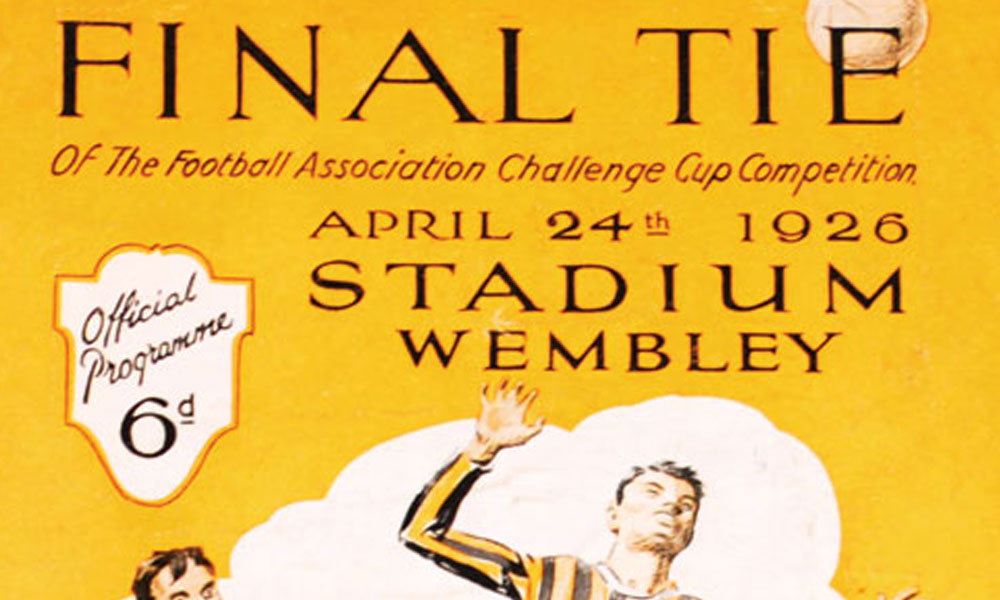
The 1920s were a golden decade for British football. The game had emerged from the disruption of the First World War, crowds were returning in huge numbers, and clubs across England and Scotland were beginning to shape the football culture that still feels familiar today. League rivalries intensified, cup finals became national occasions, Wembley opened its gates, and matchday programmes became treasured paper records of a fast-changing sport.
For collectors, the decade is especially fascinating. Old football programmes from the 1920s are not just attractive because of their age. They capture the period when football was becoming a mass spectator event, yet before programmes became standardised, glossy or commercially predictable. Many were fragile, locally printed and easily discarded, which is why surviving examples are so desirable today.
Football Finds Its Rhythm Again
The early 1920s carried a sense of renewal. Supporters who had lived through wartime disruption returned to familiar Saturday routines, and clubs had to rebuild squads, finances and local momentum. In England, the Football League expanded and settled into a structure that gave more clubs regular national competition. In Scotland, the traditional strength of Rangers and Celtic remained powerful, but the decade also produced memorable cup victories for clubs outside the Old Firm.
This is one reason 1920s programmes appeal so strongly to collectors. They belong to an era of rebuilding and reinvention. A simple league programme from the period can tell us about admission prices, ground notices, transport arrangements, club officials, team selections and local advertising. Even when the fixture itself was not famous, the programme can still feel like a piece of social history.
Huddersfield Town and the Great League Dynasty
No discussion of English football in the 1920s is complete without Huddersfield Town. Their achievement in winning three consecutive Football League titles between 1923/24 and 1925/26 remains one of the great feats in English league history. Managed first by Herbert Chapman and then by Cecil Potter, Huddersfield became the model of consistency, organisation and tactical intelligence.
For collectors, Huddersfield programmes from this period have obvious appeal. League matches involving the club during their championship years are particularly attractive, especially against major rivals or fellow title challengers. Programmes connected to Chapman’s time at Huddersfield are also important because of his later influence at Arsenal.
The value is not just in the club name. It is in the context. A Huddersfield home or away programme from the mid-1920s can represent one of the most dominant league sides England had seen.
Wembley Opens and the Cup Final Changes Forever
The 1923 FA Cup Final between Bolton Wanderers and West Ham United is one of the most famous matches in football history. Known as the White Horse Final, it was the first FA Cup Final staged at Wembley and became legendary because of the enormous crowd that spilled around the pitch before kick-off.
A 1923 FA Cup Final programme is among the most iconic rare football programmes from the decade. It links directly to the birth of Wembley as the home of English football. Bolton won the match 2-0, but the story of the day has always been larger than the scoreline.
The 1920s also produced other hugely collectable FA Cup Final programmes. Tottenham Hotspur won the 1921 final, Sheffield United lifted the cup in 1925, Bolton won again in 1926 and 1929, Blackburn Rovers beat Huddersfield in 1928, and Arsenal’s 1930 FA Cup win closed the decade in style. However, the 1927 final between Cardiff City and Arsenal stands apart. Cardiff’s 1-0 victory remains the only time the FA Cup has been won by a club from outside England, making the programme a major item for both Welsh football collectors and wider FA Cup specialists.
Dixie Dean and Everton’s Record-Breaking Season
The 1927/28 season gave English football one of its greatest individual achievements. Dixie Dean scored 60 league goals for Everton, a record that still stands as one of the most astonishing feats in the Football League.
Everton programmes from that season are highly collectable, particularly those linked to Dean’s goal chase and the club’s title success. The final match against Arsenal, when Dean reached the 60-goal mark, is especially important. It combines a legendary player, a unique record, a major club, a title-winning season and a fixture against Arsenal. For collectors, that is an exceptional combination.
Old football programmes connected to great individual records often have lasting appeal because they turn a statistic into something tangible. Dean’s 60 goals can be read in a history book, but a programme from that campaign places the collector directly inside the season as it unfolded.
Scotland’s Fierce 1920s Football Scene
Scottish football in the 1920s was equally rich. Rangers dominated much of the league landscape, while Celtic remained a major force, but the Scottish Cup delivered some wonderful variety. Partick Thistle beat Rangers in the 1921 final, Morton defeated Rangers in 1922, Airdrieonians won the cup in 1924, St Mirren beat Celtic in 1926, and Kilmarnock defeated Rangers in 1929.
These results make Scottish programmes from the decade particularly interesting. Cup final issues involving clubs outside the Old Firm can be very collectable because they mark rare triumphs and historic days for communities whose supporters still treasure those achievements.
Scottish programmes from the 1920s can also be harder to find in strong condition. Like many English issues from the same period, they were not always produced in robust formats. Some were single sheets, some were small booklets, and many were handled heavily on matchdays. Survival is part of the story.
The Most Collectable 1920s Programmes
The most desirable rare football programmes from the 1920s usually fall into several categories. FA Cup Finals are always prominent, especially the 1923 White Horse Final and the 1927 Cardiff City victory over Arsenal. Major league title matches are also attractive, particularly those involving Huddersfield Town, Everton, Newcastle United, Arsenal and other leading sides of the period.
Programmes connected to famous players carry strong interest too. Dixie Dean, Alex James, Hughie Gallacher, Charlie Buchan, Clem Stephenson and other stars of the era add depth to any fixture. A routine league game can become much more desirable if it features a major player at an important point in their career.
Scottish Cup Finals from the decade are another strong collecting area, especially when they involve historic wins for Partick Thistle, Morton, Airdrieonians, St Mirren or Kilmarnock. Early Old Firm programmes are also consistently sought after, particularly when linked to league deciders, cup ties or Hampden occasions.
Condition matters, but scarcity and story can matter more. A slightly worn programme from a landmark fixture may still be more compelling than a pristine issue from a routine match.
-

FA Cup Final - Huddersfield v Preston 30.04.1938 0-1 George Mutch penalty last minute of extra time reversing the 1922 result
-

FA Cup Final Bolton v Portsmouth 27.04.1929
-

FA Cup Final - Bolton v Manchester City 24.04.1926
-

FA Cup Final - Bolton v West Ham 28.04.1923


Why 1920s Programmes Still Have Such Pull
The 1920s sit at a perfect point for football memorabilia. The programmes are old enough to feel genuinely historic, but modern enough for the clubs, competitions and rivalries to be instantly recognisable. They connect today’s supporters with a world of packed terraces, heavy pitches, cloth caps, local printers and Saturday crowds reading team changes from thin paper sheets.
For collectors browsing 10footballs.com, the decade offers endless routes into the past. You might follow a club, a cup run, a famous player, a ground, a season or a specific competition. The best old football programmes from the 1920s are more than collectables. They are surviving witnesses to the moment when football became the national obsession we still recognise today.