

For many fans, following England is about far more than the 90 minutes on the pitch. It is memories with friends and family, the drama of tournaments, and the feeling that you are part of something bigger. One of the most tangible ways to relive those emotions is through collecting England football programmes and related memorabilia. These little booklets were never meant to be works of art or historical artefacts, yet they now sit at the heart of countless collections.
From World Cup glory to heartbreaking penalty shoot-outs, certain England programmes have become legendary in their own right. They capture moments in time, tell stories from the stands, and offer a glimpse into football history that no television replay can fully recreate.
Why England programmes mean so much to collectors
England national team programmes carry a unique pull because they combine two powerful forces: national pride and personal nostalgia. For many supporters, the first England game they attended is etched into memory – the walk up Wembley Way, the sound of the anthem, the smell of the burger vans outside. Tucked into a pocket that day was a programme, often carefully taken home and kept safe.
Programmes are also miniature time capsules. The team line-ups remind you of who started at right-back long before they became a household name. The manager’s notes capture the mood around the squad at that exact moment. Adverts show old club sponsorships, shirt designs and even long-gone brands, turning the programme into a snapshot of wider British life as well as football culture.
For England, there is an added layer of significance. Major tournament fixtures and historic friendlies are not just important to a single club’s fanbase – they are shared experiences across the whole country. When a programme comes from a match that “everyone” remembers, its appeal multiplies.
Iconic home programmes: Wembley nights and historic afternoons
Some of the most sought-after England programmes come from famous Wembley fixtures, particularly during the 1960s and 1990s.
The 1966 World Cup Final programme is arguably the crown jewel. England v West Germany at Wembley, the day England lifted the World Cup for the first – and so far only – time. Original copies from that match are prized for what they represent: the pinnacle of English football achievement. Good-condition versions, especially those actually bought on the day, are centrepieces of many collections.
Close behind are programmes from other 1966 matches, such as the opening game against Uruguay and the semi-final against Portugal. These remind collectors that a World Cup run is a journey, not just a single match. Having a full run of England’s 1966 World Cup home programmes is a dream target for many enthusiasts.
Another hugely desirable item is the programme from England v Hungary at Wembley in 1953, the famous “Match of the Century” where Hungary’s 6–3 victory shocked English football. For collectors, this isn’t just about supporting England; it’s about owning a piece of football’s tactical turning point, when old certainties were swept away in one breathtaking afternoon.
Jump forward to Euro 96 and a different kind of nostalgia kicks in. Programmes from England v Scotland (Gazza’s volley and the dentist’s chair celebration) and the semi-final against Germany are incredibly popular. These tap into the “football’s coming home” era, the soundtrack of Britpop and summers spent glued to television screens. For fans who grew up in the 1990s, these programmes are every bit as emotionally important as 1966 items are to an older generation.
-
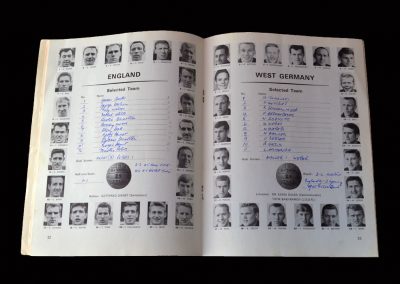
England v West Germany 30.07.1966 - World Cup Final
-
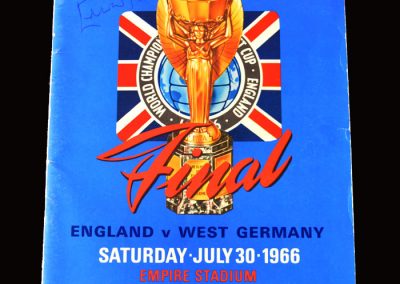
England v West Germany 30.07.1966 - World Cup Final
-

England v Poland 05.07.1966
-
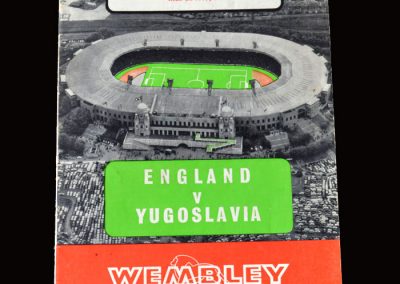
England v Yugoslavia 04.05.1966 (Peters comes in)


Famous away and tournament programmes
England’s story is not only written at Wembley. Some of the most famous programmes come from away fixtures and neutral venues at tournaments.
The programme from England’s 5–1 win over Germany in Munich in 2001 is a modern classic. It recalls a night when everything seemed possible again for England: Michael Owen’s hat-trick, the away end in full voice, and the shock of such a dominant victory over a major rival on their own turf.
Programmes from World Cups and European Championships played overseas are also highly collectable. England games at Italia 90, for example, have a special place in many hearts. The semi-final against Germany, even though it ended in penalty heartbreak, is remembered for the way it reconnected the country with the national team. Owning the programme is a way of keeping that feeling alive.
Earlier away friendlies and tours, particularly from the immediate post-war era and the 1950s, are also prized because of their relative rarity, smaller print runs and the difficulty of finding copies in good condition. For some collectors, tracking down these more obscure programmes is the most satisfying part of the hobby.
What makes an England programme so sought-after?
Not every England programme becomes famous, of course. Several factors tend to drive demand:
- Historical significance – Matches involving major milestones (World Cup and Euro games, famous wins or painful defeats) always attract interest.
- Rarity – Lower print runs, especially for away fixtures, friendlies or older games, make surviving copies harder to find.
- Condition – Programmes that have survived without writing, tears or heavy creasing are valued much more highly. Mint or near-mint copies are particularly desirable.
- Personal connection – For many fans, the “most important” programme is from the first England game they attended, or a match they watched with a family member who has since passed away.
- Signatures and extras – Autographed copies, or programmes kept alongside original ticket stubs, seat cards and match ephemera, add another layer of interest.
Because England fixtures often define eras – from 1966 to Italia 90 to Euro 96 and beyond – these programmes act almost like chapter headings in the story of supporting the national team.
Beyond programmes: England memorabilia and the wider collection
While programmes sit at the heart of many collections, they are often surrounded by other items of England memorabilia. Match tickets, scarves, rosettes, enamel badges, pennants and replica shirts all help bring an England-themed collection to life.
Collectors often enjoy building small displays around a particular game or tournament: a programme paired with the ticket, a contemporary scarf and perhaps a signed photograph of a key player. Others specialise in one type of item – for example, only World Cup programmes or only Wembley finals – keeping the focus tight but the hunt just as exciting.
England memorabilia also appeals because it usually comes with shared memories. Half the fun of showing someone an old England programme is trading stories: where you watched the game, how you felt when the winning goal went in (or the penalties went wide), and what the country was like at the time.
Starting and developing an England programme collection
For anyone looking to build or grow a collection of England programmes, it can be helpful to decide on a focus. Some collectors aim for one programme from every decade, others for a complete run of home fixtures for a particular era, and some concentrate solely on tournaments like the World Cup or Euros.
Specialist dealers and websites dedicated to football history and programmes make it much easier to find particular issues, compare conditions and learn more about each item’s background. Whether you are hunting an iconic 1966 Final programme, a Euro 96 classic or a more obscure friendly from the 1950s, part of the pleasure is the chase.
In the end, the most famous England football programmes are more than just paper souvenirs. They are fragments of shared joy and heartbreak, frozen in print. To hold one is to hold a little piece of the game’s history – and a reminder of why supporting England, through thick and thin, means so much to so many people.